The Name Asian-art/bushido-code-of-the-samurai.php in Chinese/Japanese on a Personalized Wall Scroll.
Click the "Customize" button next to your name below to start your personalized asian-art/bushido-code-of-the-samurai.php calligraphy artwork...
Switched to secondary search mode due to lack of results using primary.
These secondary results may not be very accurate. Try a different but similar meaning word or phrase for better results. Or...
Look up in my Japanese Kanji & Chinese Character Dictionary(My dictionary is a different system then the calligraphy search you just tried)
If you want a special phrase, word, title, name, or proverb, feel free to contact me, and I will translate your custom calligraphy idea for you.
2. Animals
3. Appreciation of Truth by Meditation
5. Asian Pride / Oriental Pride / AZN Pryde
6. Bamboo
8. Banzai
9. Beautiful
10. You are always a beauty in your lover’s eyes
11. Beauty Shop / Beauty Salon
12. Benevolence
14. Big Wave
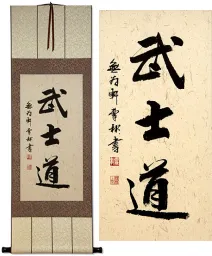
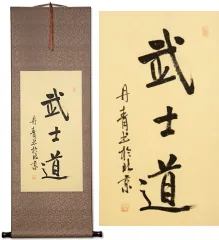
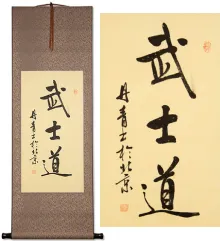
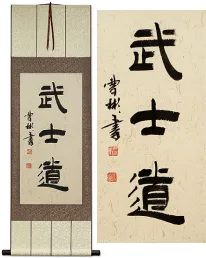
16. Bushido / The Way of the Samurai
17. Bushido Dragon
18. Bushidokan
19. Bushi Kai
21. Cobra
22. Code Of Silence
23. Do not shed a tear until you see the coffin
24. Community
25. The Five Tenets of Confucius
27. Crisis equals Danger plus Opportunity?
28. Crystal
29. Daisy
30. Daoism / Taoism
31. Dignity / Honor / Sanctity / Integrity
32. Double Happiness Guest Book
35. Easter
36. Amitabha Buddha
38. Enso - Japanese Zen Circle
39. Let Us Try
40. Eye for an eye
41. Filial Piety
42. A Bright Future
43. Flower in the Mirror, Moon on Water
44. Forgive
45. Forgiveness
46. Gem
47. Grace from Heaven / Grace from God
49. Guanxi
50. Gung Ho
51. In Flowers the Cherry Blossom, In Men the Samurai
52. Heaven
53. Words Have Enormous Weight: One Word Worth Nine Caldrons
54. Speed
56. Honesty
59. Honor
60. Achieve Inner Peace; Find Deep Understanding
61. Jackie Chan
62. Joshua 24:15
64. Justice / Rectitude / Right Decision
65. Kana
66. Karma
67. Katana
69. King
70. Kirin / Giraffe / Mythical Creature
71. Life Energy / Spiritual Energy
73. Listen to Both Sides and be Enlightened, Listen to One Side and be in the Dark
74. Live Laugh Love
76. Love
77. Loyalty
78. Loyalty / Faithful / Devoted
79. Midori
80. Mind Body Spirit
81. Moon
82. Morera
84. Musashi
85. Music
86. Musician
88. Naranu Koto Wa Naranu Mono Desu
89. Nashi
90. Navy
91. Ninja
92. Opera
93. Peace / Harmony
94. Peaceful Warrior
95. Phenomenon
97. Purple / Violet
Air / Atmosphere
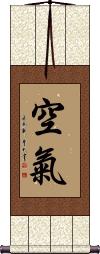
空氣 means air or atmosphere in Chinese, Japanese Kanji, and old Korean Hanja.
This is an unusual title for an Asian calligraphy wall scroll, but many of our western customers have requested it.
 While 空氣 is common in Chinese and Korean Hanja (and ancient Japanese Kanji); please note that in modern Japanese, the second character is written as 気, with slightly fewer strokes. If you want the modern Japanese version, please click on the character to the right. Both versions are understood by native Chinese, Japanese, and many (but not all) Korean people. You should choose the appropriate version based on the intended audience for your calligraphy artwork.
Animals
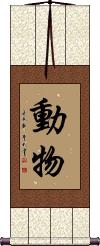
動物 is the way to write “animals” in Chinese characters, Japanese Kanji, and old Korean Hanja.
The first character means “moving,” and the second means “things.”
So animals are “moving things” in these Asian languages.
Appreciation of Truth by Meditation
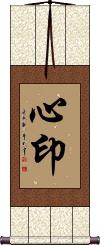
心印 is a Buddhist concept that simply stated is “appreciation of truth by meditation.”
It's a deep subject, but my understanding is that you can find truth through meditation, and once you've found the truth, you can learn to appreciate it more through further meditation. This title is not commonly used outside of the Buddhist community (your Asian friends may or may not understand it). The literal translation would be something like “the mind seal,” I've seen this term translated this way from Japanese Buddhist poetry. But apparently, the seal that is stamped deep in your mind is the truth. You just have to meditate to find it.
Soothill defines it this way: Mental impression, intuitive certainty; the mind is the Buddha-mind in all, which can seal or assure the truth; the term indicates the intuitive method of the Chan (Zen) school, which was independent of the spoken or written word.
Reference: Soothill-Hodous Dictionary of Chinese Buddhism
See Also: Zen
Asia / Asian Continent
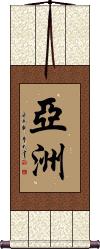
Asia / Asian Continent
Asian Pride / Oriental Pride / AZN Pryde
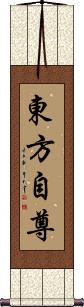
東方自尊 is the universal way to write “Asian Pride.”
We worked on this one for a long time. The effort involved both Chinese and Japanese translators and lengthy discussions. If you have been searching for this term, there is a reason that it's hard to find the way to write “Asian Pride” in Chinese and Japanese - it's because of the inherent difficulties in figuring out a universal combination of characters that can be read in all languages that use forms of Chinese characters.
This final solution that you see to the left creates a reasonable title in Chinese and an exotic (perhaps unusual) title in Japanese (This could be read as “Eastern Self-Respect” in Japanese”).
Although not as natural, it does have the same meaning as Korean Hanja, and the older generation of Vietnamese people will be able to read it.
The first two characters literally mean “Oriental” and the second two mean “pride,” “self-esteem,” or “self-respect” (we chose the most non-arrogant way to say “pride”). If you have “Asian Pride” (sometimes spelled Asian Pryde) these are the characters for you.
Note: For those who wonder, there is nothing technically wrong with the word “Oriental.” It is a correct word, and any bad meanings were created by so-called “Asian Americans” and Caucasians in the United States. To say “Asian” would not completely correct the intended meaning since that would include people from Saudi Arabia, Iraq, Iran, India, and portions of Russia.
For further proof, if you were of East Asian ancestry and born in England, you would be known as a “British Oriental” (The “Oriental stigma” is basically an American creation and, therefore, applies mainly to the American English language - where they get a bit overzealous with political correctness).
Further, since the Chinese and Japanese word for Oriental is not English, they can not be construed as having ill meaning. On one trip to China or Japan, you will find many things titled with these two characters, such as malls, buildings, and business names. These places also use “Oriental” as their English title (much as we do since our Chinese business name starts with these same two characters).
In short, the first two characters have the meaning that Americans attach to “Asian” but is more technically correct.
Bamboo
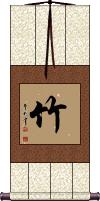
竹 is the character that means bamboo in Chinese, Japanese Kanji, and old Korean Hanja.
In Asian cultures, bamboo is often seen as a symbol of a noble gentleman (tall, straight, and honest).
There are also some multi-character bamboo words that regard individual bamboo plants, species of bamboo, bamboo as lumber, and edible bamboo shoots. However, this single character seems most appropriate for a wall scroll and covers the whole category of Asian bamboo.
Banzai / Wansui
Old Japanese / Traditional Chinese & Korean
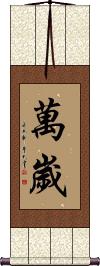
萬歲 is the traditional Chinese, Korean Hanja, and ancient Japanese way of writing banzai.
In modern times, the first character was simplified in Japan and China. So you might want to select the other entry for universal readability.
While it has become a popular, if not an odd, thing to scream as you jump out of an airplane (preferably with a parachute attached), banzai is actually a very old Asian way to say “hooray.” The Japanese word “banzai” comes from the Chinese word “wan sui,” which means “The age of 10,000 years.” It is actually a wish that the Emperor or the Empire live that long.
Imagine long ago when the Emperor made a rare public appearance. 萬歲 is what all people would yell to their leader in respect.
So if you like it as a hooray, or you want to wish someone that they live for 10,000 years, this is the calligraphy for you.
Other translations include Cheers! (not the drinking kind), hurrah!, long live [name]!, and congratulations!
To other things with banzai in their names, I am still waiting for the promised sequel to Buckaroo Banzai.
Notes: Sometimes people confuse banzai with bonsai. A bonsai is a miniature tree. They have nothing to do with each other.
Banzai
Modern Japanese Version
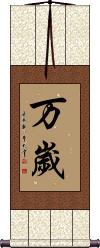
万歲 is the modern Japanese way to write banzai.
We've made two almost identical entries for this word, with just a variation on the first character. In the last century, 萬 was simplified to 万 in Japan and China. The new generation will expect it to be written as 万 but the old generation can still read the more traditional 萬 form. You must make your determination as to what version is best for you. If your audience is mostly Japanese, I suggest 万歲.
While it has become a popular, if not an odd, thing to scream as you jump out of an airplane (preferably with a parachute attached), banzai is actually a very old Asian way to say “hooray.” The Japanese word “banzai” comes from the Chinese word “wan sui” which means “The age of 10,000 years.” It is actually a wish that the Emperor or the Empire live that long.
Imagine long ago when the Emperor made a rare public appearance. This is what all of the people would yell to their leader in respect.
So if you like it as a hooray, or you want to wish someone that they live for 10,000 years, this is the calligraphy for you.
To other things with banzai in their names, I am still waiting for the promised sequel to Buckaroo Banzai.
Other translations: hurrah, long life, congratulations, cheers, live long.
Notes: Sometimes people confuse banzai with bonsai. A bonsai is a miniature tree. They have nothing to do with each other. Further, Bonzai is not a word at all - although it would make a great name for a calcium supplement for older people.
Beautiful
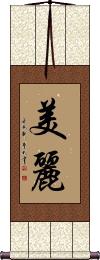
美麗 is a two-character word used often in Chinese, old Korean, and ancient Japanese to express beauty.
I've had a few requests for a “two-character beautiful,” and this is by far the best word. This is not a common word for an Asian person to want on a wall scroll. However, you will see it commonly used as an adjective in phrases, stories, and titles throughout magazines and signage in China.
美麗 can also be translated as gorgeous or lovely.
Note: 美麗 is not commonly used in modern Japan.
You are always a beauty in your lover’s eyes
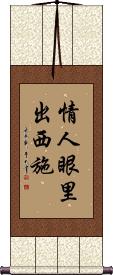
Any woman with affection for Asian art will love a gift of this Chinese proverb calligraphy on a wall scroll.
She will melt in your arms as you tell her the meaning of these characters.
Contained in this phrase is a reference to the most beautiful woman in Chinese history. Her name was Xi Shi, and she was known to have good looks that need not have fine robes or makeup. Her charms were so powerful that she brought down an entire kingdom (in a successful effort to bring honor and pride back to her people).
情人眼里出西施 is a great way to express that the woman in your life is your one love.
Beauty Shop / Beauty Salon
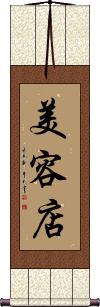
美容店 is how to write “Beauty Shop” or “Beauty Salon.”
If you own such a business, this will make a nice wall scroll to hang up - and many of your Asian customers will be able to read and appreciate it.
When traveling in China, you will see signs like this in the window of any place that offers full services of hair styling, manicures, pedicures, and often shampoo with head and back massage.
However, as a handmade wall scroll, this becomes a very fancy piece of artwork that shows the high class of your business (a great sign for your window if you don't get direct sunlight).
Benevolence
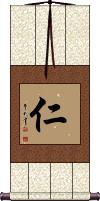
Beyond benevolence, 仁 can also be defined as “charity” or “mercy” depending on context.
The deeper meaning suggests that one should pay alms to the poor, care for those in trouble, and take care of his fellow man (or woman).
仁 is one of the five tenets of Confucius. In fact, it is a subject that Confucius spent a great deal of time explaining to his disciples.
I have also seen this benevolent-related word translated as perfect virtue, selflessness, love for humanity, humaneness, goodness, goodwill, or simply “love” in the non-romantic form.
This is also a virtue of the Samurai Warrior
See our page with just Code of the Samurai / Bushido here
Kindness / Benevolence
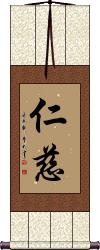
仁慈 word is used in Chinese, Korean, Japanese, and Asian Buddhism to relay the important idea of loving kindness.
仁慈 can also be defined as: benevolent; charitable; kind; merciful; kind-hearted; benevolence; kindness; humanity; mercy.
In Japanese, this can also be the given name Hitoji. This would also be a good Mandarin Chinese given name romanized as Jentzu (in Taiwan) or Renci (which sounds like ren-tsuh).
Big Wave
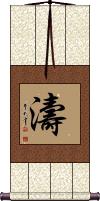
濤 is the Chinese character for “Big Wave.”
It suggests a wave unlike most, strong and powerful.
濤 is technically also a Japanese Kanji, and Korean Hanja but it's not commonly used in those Asian languages. Pronunciation in Japanese and Korean is provided above for reference only. Just order this if your audience is Chinese.
Bravery / Courage
Single Character for Courage
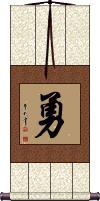
勇 can be translated as bravery, courage, valor, or fearless in Chinese, Japanese and Korean.
勇 is the simplest form to express courage or bravery, as there is also a two-character form that starts with this same character.
勇 can also be translated as brave, daring, fearless, plucky, or heroic.
This is also a virtue of the Samurai Warrior
See our page with just Code of the Samurai / Bushido here
Bushido / The Way of the Samurai
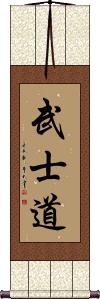
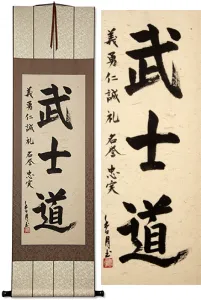
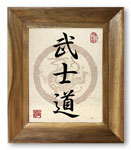
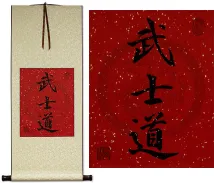
武士道 is the title for “The Code of the Samurai.”
Sometimes called “The Seven Virtues of the Samurai,” “The Bushido Code,” or “The Samurai Code of Chivalry.”
This would be read in Chinese characters, Japanese Kanji, and old Korean Hanja as “The Way of the Warrior,” “The Warrior's Way,” or “The Warrior's Code.”
It's a set of virtues that the Samurai of Japan and ancient warriors of China and Korea had to live and die by. However, while known throughout Asia, this title is mostly used in Japan and thought of as being of Japanese origin.
The seven commonly-accepted tenets or virtues of Bushido are Rectitude 義, Courage 勇, Benevolence 仁, Respect 礼(禮), Honour 名誉, Honesty 誠, and Loyalty 忠実. These tenets were part of oral history for generations, thus, you will see variations in the list of Bushido tenets depending on who you talk to.
See our page with just Code of the Samurai / Bushido here
Bushido Dragon

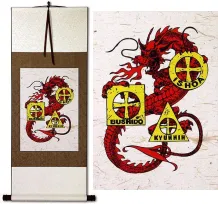
This is the title Bushido Dragon in Chinese and Japanese Kanji.
In Japanese, this can also be written as 武士道竜.
Bushidokan
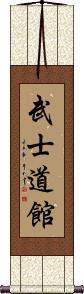
武士道館 is the title Bushidokan or Bushido-Kan.
Bushi Kai
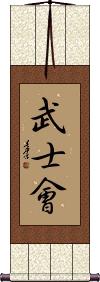
Chong / Sung / Su
Surname
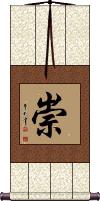
This is the surname “Chong” or “Zhong” in Mandarin Chinese, “Sung” in Cantonese and Korean, and Su in Japanese.
崇 is used in other Chinese words and other Asian languages with the following meanings:
high; sublime; lofty; to esteem; to worship; eminent; honorable; honourable; reverence; adore/adoration.
Cobra
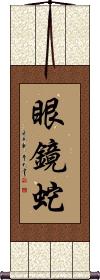
眼鏡蛇 is the Chinese and Japanese Kanji for cobra
This title may refer to the spectacled cobra, Indian cobra, or Asian cobra.
Code Of Silence

沉默法則 means “The Code Of Silence” or "The Rule of Silence” in Chinese.
Do not shed a tear until you see the coffin
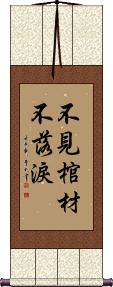
不見棺材不落淚 is a cautionary tale that suggests you are unknowingly (though it should be obvious)on a bad course.
It further suggests that you will not realize your folly until the worst has happened.
This can also be a warning of inaction until it's too late to take action. Again, not realizing your error until it's too late.
In an alternate interpretation, some will suggest this means doing something bad and not looking back - Then the worst happens.
It should be noted that this is one of the oddest selections for a wall scroll in our whole Asian calligraphy database. All of our translators are convinced that no Chinese person would ever hang this on their wall.
Community
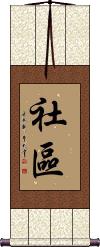
社區 is how to write community in Chinese.
社區 can mean the neighborhood you live in. It can also be used the same way we use the word community in English.
Examples: African-American community, Christian community, Asian community, etc.
If you need a special calligraphy wall scroll to describe your community, just contact me, and I’ll translate it and make it for you.
The Five Tenets of Confucius
The Five Cardinal Rules / Virtues of Confucius
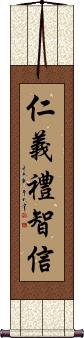
仁義禮智信 are the core of Confucius's philosophy.
Simply stated:
仁 = Benevolence / Charity
義 = Justice / Rectitude
禮 = Courtesy / Politeness / Tact
智 = Wisdom / Knowledge
信 = Fidelity / Trust / Sincerity
Many of these concepts can be found in various religious teachings. It should be clearly understood that Confucianism is not a religion but should instead be considered a moral code for a proper and civilized society.
This title is also labeled “5 Confucian virtues.”
 If you order this from the Japanese calligrapher, expect the middle Kanji to be written in a more simple form (as seen to the right). This can also be romanized as "jin gi rei satoshi shin" in Japanese. Not all Japanese will recognize this as Confucian tenets but they will know all the meanings of the characters.
See Also: Confucius Teachings | Ethics
Crazy / Mad / Wild
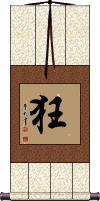
狂 is a single character that means “crazy” in Chinese, Japanese Kanji, and old Korean Hanja.
狂 means crazy, unrestrained, lunatic, insane, confused, deranged, wild, or mad.
This can also refer to an extreme enthusiast (like a football fan). But then, it can also refer to a person possessing a mental abnormality.
In some contexts, this can mean conceited (it probably won't be read that way on a wall scroll).
A warning: 狂 is an odd selection for a wall scroll. You should only order this if you plan to bewilder or confuse those who see it. It kind of says something about you, something that most native Asian people will not view in a good light.
Crisis equals Danger plus Opportunity?
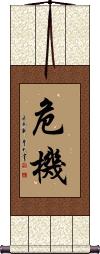
危機 means crisis in Chinese and Japanese.
Separately, the first character here does mean “danger” or “to endanger,” and the second character can mean “opportunity.”
However, I want to debunk a myth that was propagated by some westerners who did not have a clear understanding of Asian languages...
While often, Chinese/Japanese/Korean compound words (words of two or more characters) are the sum of their parts, this is not always the case. The compound is often understood with a completely different meaning than the two characters individually.
Many have said that the Chinese/Japanese/Korean word for Crisis is made up of the characters for “danger” and “opportunity.” 危機 is true when phrased this way.
However, it's not absolutely correct to say that “danger + opportunity = crisis” in Asian cultures.
English example:
If I tell you that...
Bovine creature + Guy behind the plate in baseball = Locomotive train protection

...you would think I was mad. But consider that “cow + catcher = cowcatcher,” which is the device that used to be found on steam engines to protect them if they hit an animal on the tracks. When we hear the word “cowcatcher,” we don't separate the words into their individual meanings (necessarily).
The same is true with the word for crisis in Chinese/Japanese/Korean. While you can separate the characters, few Asian people would automatically do so in their minds.
The final answer:
It is a half-truth to say, “danger plus opportunity equals crisis” in Chinese/Japanese/Korean. Use this statement and concept with caution.
Also, the second character can mean “secret” or “machine,” depending on context so I guess you have to say “a dangerous machine = crisis” or “danger + a secret = crisis.” Both of these are only slightly more ridiculous than the first premise.
PS: 危機 is probably not a great word for a scroll unless you have a special use for it.
Crystal
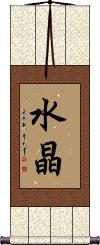
This word means “crystal” such as fine crystal glassware or diamonds in Chinese, Japanese, and Korean Hanja.
水晶 is a cool selection if your name is Crystal, as it will match your name by meaning (rather than pronunciation).
It's also cool because it will universally contain the meaning of your name in most Asian languages.
Daisy
The yellow flower
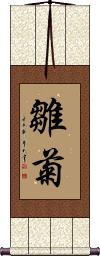
雛菊 is how they write “daisy” in Chinese and Japanese.
This is a good choice if you love daisies, or your name is Daisy. If you translated it directly, this means “chick flower” (as in baby chickens) or “baby chrysanthemum.” Of course, when an Asian person reads this, they just think “daisy.”
If you're into botany, this title represents “Bellis Perennis.”
In Japanese, this can be the female given name, Hinagiku.
Daoism / Taoism
Literally: The Way or Road
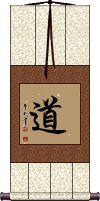
道 is the character “dao” which is sometimes written as “tao” but pronounced like “dow” in Mandarin.
道 is the base of what is known as “Taoism.” If you translate this literally, it can mean “the way” or “the path.”
Dao is believed to be that which flows through all things and keeps them in balance. It incorporates the ideas of yin and yang (e.g. there would be no love without hate, no light without dark, no male without female.)
The beginning of Taoism can be traced to a mystical man named
Lao Zi (604-531 BC), who followed, and added to the teachings of Confucius.
More about Taoism / Daoism here.
Note that this is pronounced “dou” and sometimes “michi” when written alone in Japanese but pronounced “do” in word compounds such as Karate-do and Bushido. It's also “do” in Korean.
Alternate translations and meanings: road, way, path; truth, principle province.
Important Japanese note: In Japanese, this will generally be read with the road, way, or path meaning. Taoism is not as popular or well-known in Japan so Daoist/Taoist philosophy is not the first thing a Japanese person will think of when they read this character.
See our Taoism Page
Dignity / Honor / Sanctity / Integrity
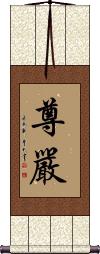
尊嚴 is a form of honor that means showing great respect for yourself, other people, and the rules you live by.
When you are honorable, you keep your word. You do the right thing regardless of what others are doing.
尊嚴 is the kind of personal honor or dignity that is of great value. If you lose this, you have lost yourself and perhaps the reputation of your family as well.
While this is not directly the same thing as “face” or “saving face” in Asian culture, it is associated with the same concept in China.
 In Japan, they currently use a more simplified second character for this word. The ancient Japanese form is the same as China but after WWII some Kanji were changed. If you want the modern Japanese version, just click on the Kanji image shown to the right, instead of the button above.
Double Happiness Guest Book
Customize a special Asian guest book for your wedding
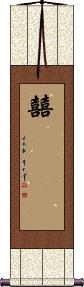
Start customizing a “Double Happiness Guest Book Wall Scroll” Here!
The paper panel length can be whatever you choose from 68cm to 135cm (27” to 53”).
If you don't mention what paper length you want in the special instructions tab (on the next page), we'll make it about 100cm (40”).
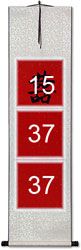
The medium-size scroll with a 33cm x 100cm (13” x 40”) paper panel can usually handle up to 89 signatures. That breaks down to 37 signatures per empty square and 15 signatures around the 囍 character. If you switch to a 135cm paper panel, add another 37 potential signatures.
We can splice two 135cm papers together, but that would be a crazy-long scroll. These are only estimates, your mileage may vary.
With silk panels, this will yield a wall scroll about 155cm (61”) long. That's enough for up to 89 signatures. Of course, that depends on if your guests just sign a brief salutation and name, or more verbose good wishes. Customer feedback is that 126 people can sign the 135cm long paper on a medium-sized scroll. If we go bigger than that, there will be a minor paper seam and an extra charge. Email me with your specifications if you need something special.
Most customers pick the festive red paper with gold flecks and white or ivory silk. Red is a good luck color in Chinese culture, thus the most popular choice. But, you can do any color combination that you want.
There is a long history of Chinese-character-use outside of mainland China. This Double Happiness character is also seen at weddings in Korea, Vietnam, Hong Kong, and Taiwan, as well as in Chinese communities in Thailand, Indonesia, and elsewhere. While Japan borrowed Chinese characters into their language, you won't see 囍 as often at Japanese weddings.
Dragon / Emperor Symbol
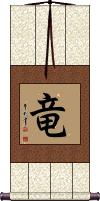
竜 is an alternate form of the dragon.
Still pronounced the same in Chinese, Japanese, and Korean.
This particular Kanji is often associated as an imperial symbol as well as representing the mythical Asian dragon. You may have seen it on the chest or flag of the emperor in old Japanese and Chinese movies.
Note: I would rate this as a non-universal alternate form. The other dragon character is by far more common, and universally understood.
We strongly recommend  if you are looking for the symbol of dragon.
Eagle / Falcon / Hawk
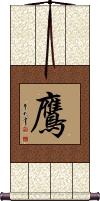
鷹 is the way to write eagle, falcon, or hawk in Chinese.
It means hawk or falcon in Japanese Kanji, and simply “eagle” in old Korean Hanja. Though we have different words for them in English, eagles, falcons, and hawks are all seen as the same general type of bird in Asian languages.
If you are looking for the Dutch surname Valk, or the German surname Falco by meaning, this would be a good character for you.
There are other multi-character words (most of them contain this character) which express different specific species of birds of prey (bald eagle, osprey, golden eagle, etc). If you need a more specific title, just contact me.
Easter
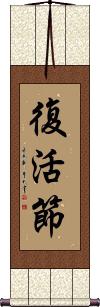
復活節 is the Chinese and old Korean way to write Easter.
Easter is not a well-known holiday in China, but Chinese Christians tend to follow the American tradition of the Easter egg ritual, etc. Non-Christians may think it's a celebration of rabbits that can lay eggs.
South Korea has a higher percentage of Christians than any other Asian country, so they celebrate Easter with plenty of enthusiasm.
Amitabha Buddha
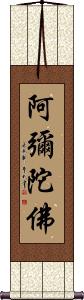
This title can mean the Buddha of the Western paradise.
But it's more a chant that means “May the lord Buddha preserve us!” or “Merciful Buddha!.”
阿彌陀佛 is also a translation to Chinese, Japanese, and Korean for “Amitâbha Buddha.”
Asian Buddhists will often greet and say goodbye to each other with this phrase/chant/title.
Enlightened Warrior
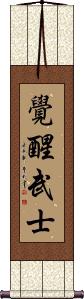
覺醒武士 is not a commonly used title in Chinese but is sometimes used in Martial arts and military contexts to refer to a warrior who seems always to be fully aware, enlightened, knowledgeable, noble, and just.
The first two characters are a word that means: to awaken; to come to realize; awakened to the truth; the truth dawns upon one; scales fall from the eyes; to become aware.
The last two characters mean warrior but can also refer to a samurai, soldier, or fighter.
Enso - Japanese Zen Circle
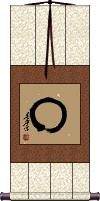
〇 is the famous Enso symbol, which you will see widely used by Japanese Zen Buddhists.
In a twist, I am starting to see Enso used more and more by Chinese Buddhists.
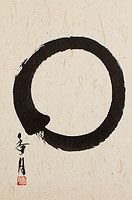
Here is the typical appearance of Enso artwork by Japanese calligrapher Kougetsu.
Enso is not a Japanese Kanji character. It falls more into the category of a symbol. There is some debate, but many consider Enso to be a religious symbol.
Some call this “The Circle of Enlightenment.” Others call it the “Infinity Circle.” If you actually took the meanings of the two Kanji (円相) that make up the word “En-so,” you could read it as “Mutual Circle” or “Circle of Togetherness.” I think the Enso symbol can simply mean different things to different people. Therefore, you should let it have the meaning that you perceive.
The appearance of your Enso will be determined by the artist's personal style, feeling, mood, etc.
Let Us Try
Essayons
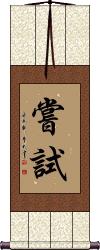
嘗試 is a close match for the English phrase “let us try” or the French word “Essayons.”
 Essayons the motto of Combat Engineers in the U.S. Army.
This word can also be translated as “to try” or “to attempt.”
Even if you're not a Combat Engineer, this word should inspire you to attempt to accomplish difficult things. If you don't try, you are certain to fail; if you do try, at least there is a chance of success.
The worst thing is not failure, the worst thing is not trying at all.
Eye for an eye
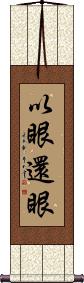
以眼還眼 is the same proverb that seems to be used in virtually every language and culture worldwide.
Whether you are Arab, Persian, Jewish, European, British, Asian, or American, this proverb is well known as the “original form of justice.”
Filial Piety
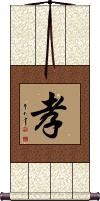
孝 represents filial piety.
Some will define this in more common English as “respect for your parents and ancestors.”
孝 is a subject deeply emphasized by the ancient philosophy and teachings of Confucius.
Some have included this in the list for the Bushido, although generally not considered part of the 7 core virtues of the warrior.
Note: 孝 is not the best of meanings when seen as a single character. Some will read the single-character form to mean “missing my dead ancestors.” However, when written as part of Confucian tenets, or in the two-character word that means filial piety, the meaning is better or read differently (context is important for this character).
We suggest one of our other two-character filial piety entries instead of this one.
A Bright Future
Incredible 10,000-Mile Flight of the Peng
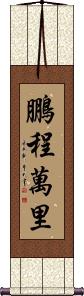
鵬程萬里 is an ancient Chinese proverb used in modern times to wish someone a long and successful career.
It's really about the 10,000 Flight of the Peng (Peng, also known as Roc is a mythical fish that can turn into a bird and take flight).
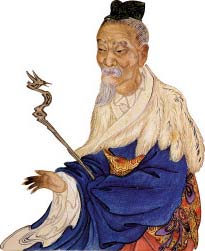
莊子
Zhuangzi or Chuang Tzu
Breaking down each character:
1. Peng or Roc (a kind of bird).
2. Journey (in this case, a flight).
3. 10,000 (Ten Thousand).
4. Li is a unit of distance often referred to as a “Chinese Mile,” though the real distance is about half a kilometer.
Direct Translation: “Peng's Journey [of] 10,000 Li.”
Literal meaning: “The 10,000-Li Flying Range Of The Roc.”
Perceived meaning: “To have a bright future” or “To go far.”
This proverb/idiom comes from the book of Zhuangzi or Chuang Tzu. It tells the tale of a huge fish that could turn into a gigantic bird. This bird was called a “peng” and was many miles long. This legendary size allowed the Peng to fly from the Northern Sea to the Southern Sea in a single bound.
Wishing someone “a Peng's Journey of 10,000 Li” will imply that they can travel far without stopping and will have great success, a long career, and a prosperous future.
Flower in the Mirror, Moon on Water
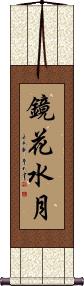
鏡花水月 is an old Asian proverb that means “flowers in a mirror and the moon reflected in the lake” or “flowers reflected on a mirror and the moon reflected on the water's surface.”
Literally, 鏡花水月 reads “Mirror Flower, Water Moon.”
Figuratively this can be used to represent a lot of different ideas. It can be used to express an unrealistic rosy view or viewing things through rose-tinted spectacles. So you can use it to relay an idea about something that is visible but has no substance,
something that can be seen but not touched, or something beautiful but unattainable such as dreams or a mirage.
This expression is used to describe things like the subtle and profound beauty of poems that cannot be described in words.
鏡 = Mirror (or lens)
花 = Flower(s)
水 = Water
月 = Moon
Can also be written 水月鏡花 (just a slight change in word/character order).
Forgive
Deep heartfelt forgiveness
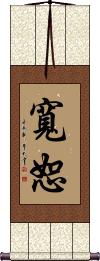
寛恕 is a word of Chinese origin means forgive or forgiveness.
寬恕 is a deep kind of forgiveness from the bottom of your heart.
In a religious context, this is the kind of forgiveness that you beg God for and that God grants you.
In Korean Hanja, this can also be defined as forbearance or leniency.
In Japanese Kanji, beyond forgiveness, this can also mean magnanimity or generosity.
While we don't actively recommend Asian tattoos, this would be the forgiveness title that is best for a tattoo in most cases.
 Note: The first character can also be written in the form shown to the right (especially in Japanese). If you have a preference, please let us know in the "special instructions" when you place your order.
Forgiveness
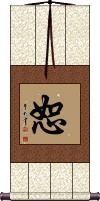
恕 means to forgive, show mercy, absolve, or excuse in Chinese and Korean Hanja (though mostly used in compound words in Korean).
恕 incorporates the pictogram of a heart at the bottom, and a woman and a mouth at the top. The heart portion has the most significance, as it is suggested that it is the heart's nature to forgive.
In Asian culture, as with most other cultures, forgiveness is an act of benevolence and altruism. In forgiving, you put yourself in someone else's shoes and show them the kindness that you would want them to show you. Confucius referred to this quality as “human-heartedness.”
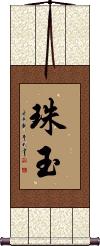
珠玉 is a Chinese, Japanese Kanji, and old Korean Hanja word meaning gem.
Beyond just the word gem, this can refer to pearls and jades, jewels, clever remarks, beautiful writing, gems of wisdom, genius, or an outstanding person.
If your name is Gem, this is a nice way to represent your name in 3 Asian languages. Though the pronunciation will be far from Gem, the meaning of gem is really nice.
Note: In Japanese, this is sometimes used as the female given name, Tama.
Grace from Heaven / Grace from God
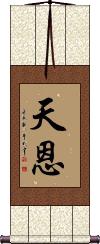
天恩 is the deepest way to say “Heaven's Grace” or “God's Grace” in Chinese.
The first character means Heaven or sky (referring, in this case, to the domain of God).
The second character means grace, blessings, benevolence, favor/favour, acts of kindness, merits, or beneficial influence.
This title can also be defined as:
Blessings of Heaven, Favor of the Emperor, Divination's luckiest day, or blessings of nature. Note: When you see “Emperor” above, remember that the Emperor, like the Pope, is theoretically chosen by God or seen as an emissary or conduit of God in ancient Asian culture. It would only be read that way in a certain context, such as “The Emperor, in his mercy, bestowed upon him Heaven's Grace, and the prisoner was set free.”
Note: Technically, this is a Japanese word too (pronounced "ten-on") but it’s rarely used in Japan anymore. Therefore, this title is best if your audience is Chinese.
Griffin / Gryphon
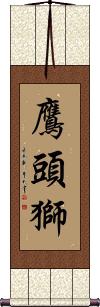
鷹頭獅 is the Chinese title for a Griffin.
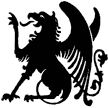 This refers to the legendary creature with the head, talons, and wings of an eagle and the body of a lion. Sometimes also spelled Gryphon or Griffon. From the Greek γρύφων or γρύπων, or Latin Gryphus.
This Chinese title, 鷹頭獅, literally means “Eagle Head Lion.”
Guanxi
The Chinese Concept of Relationship and Exchange of Favors
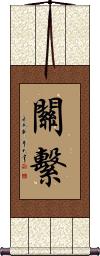
The dictionary definition is:
Relations/relationship, to concern, to affect, to have to do with, or connection.
But there's more to it...
In China, the relationship that you have with certain people can open doors for you. Having guanxi with someone also means they would never defraud you but are honor-bound to treat you fairly (of course, this goes both ways). Sometimes it is suggested that guanxi is the exchange of favors. 關繫 / 関繫 / 關係 is more about having a relationship that allows you to ask for and expect favors without shame.
There is no concept in western culture that exactly matches guanxi, but perhaps having a social or professional network is similar.
Note that there are some variations common within Chinese, Japanese Kanji, and Korean Hanja for this word... Japanese tend to use a Chinese alternate form as shown to the right for
the first character.
 There's also another alternate form of that first character (currently used as the official Simplified form in mainland China) which looks like the character shown to the right. It's basically the central radical of the alternate version shown above but without the “door radical” around it. In more free-flowing calligraphy styles, this version would be the likely choice for a calligrapher.
 In Modern Japanese, they use the character shown to the right.
They also tend to use this same form in Korean Hanja (I've only checked this word in my Korean dictionary, but it has not been confirmed by a translator's review).
 If that was not confusing enough, there is another alternate form of that second character. See right.
An Asian calligrapher of any nationality may use these forms at their discretion. However, They would tend to stick to the most common form used in their respective languages.
If you have any preference on any of these issues, please give us a special note with your order, and we'll make sure it's done the way you want.
Gung Ho
Working Together
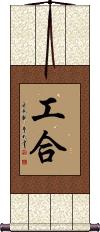
工合 is one of those Asian words that is used more in English than in the original Chinese.
Gung Ho was originally used to speak of Carlson's Raiders, a group of “Gung Ho” U.S. Marines who went on an island-hopping campaign of death during WWII.
A movie called Gung Ho came out in the mid-1940s and was later re-released in the 1950s depicting the 2nd Marine Raider Battalion, and brought this word to the mainstream.
It is still sometimes used today within the U.S. Marine Corps brotherhood to refer to a unit or group that works well together or is otherwise efficient and motivated (has good morals).
In 1986, there was a movie called Gung Ho about a Japanese company taking over an American automotive factory. They completely ignored the fact that this was a Chinese title.
It should be noted that this title actually means a condition, state, manner, or the health of something in Japanese.
Language and pronunciation notes:
Like many Asian words absorbed into common use in English, this one is drastically mispronounced. The official Romanization is “gong he” but that doesn't tell you enough. The vowel sound on the first character is like the English word “own,” now just add the g-sounds to the beginning and end. The second character is misleading, as you might think it is like the English word “he.” In reality, the vowel sound is more like the “u” in “up.”
It should also be noted that the current generation in China no longer uses or recognizes this as a common word or slogan.
Note: This can be pronounced and is a word in Japanese, though seldom used. Japanese will use a variation of "具合" instead. But still, not common.
In Flowers the Cherry Blossom, In Men the Samurai
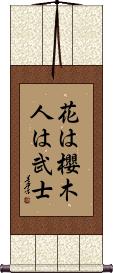
This Japanese proverb simply reads, “[In] Flowers it's Cherry Blossoms, [In] Men it's Warriors.”
花は櫻木人は武士 is meant to say that of all the flowers in the world, the cherry blossom is the best. And of all men in the world, the Samurai or Warrior is the best
This proverb has been around for a long time. It's believed to have been composed sometime before the Edo Period in Japan (which started in 1603).
Some will drop one syllable and pronounce this, “hana wa sakura hito wa bushi.” That's “sakura” instead of “sakuragi,” which is like saying “cherry blossom” instead of “cherry tree.”
The third character was traditionally written as 櫻. But in modern Japan, that became 桜. You may still see 櫻 used from time to time on older pieces of calligraphy. We can do either one, so just make a special request if you want 櫻.
Note: Because this selection contains some special Japanese Hiragana characters, it should be written by a Japanese calligrapher.
Heaven
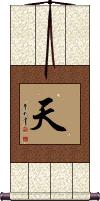
天 means “heaven” or “sky” in Chinese, Japanese Kanji, and old Korean Hanja.
The context determines if you are talking about heaven or the sky above (often they are the same concept).
When combined with other characters, words like “today” and “tomorrow” are created. While sometimes the character for “sun” is used to mean “day,” often “sky” represents “day” in Asian languages.
Example: 今天 (this sky) = “today,” 明天 (next sky) = “tomorrow” in modern Chinese and Japanese.
In Chinese culture, regardless of which religion, it's almost always assumed that God (and any other deities) live up above the sky. The concept of God living in the sky is likely the reason heaven is associated with this character.
The equation goes something like this: God's domain is the sky, thus, the sky is heaven.
Note: As a single character, this is a little ambiguous, so you might want to choose our Kingdom of Heaven selection instead.
Words Have Enormous Weight: One Word Worth Nine Caldrons
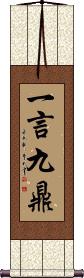
一言九鼎 is an ancient Chinese proverb used in modern times to talk of profound or powerful words.
 The literal meaning is “one word [worth] nine [sacred] tripods.” The tripod is a highly-prized three-legged (sometimes four-legged) metal pot or kettle of ancient China. They are often made of bronze, and the Emperor would have large ones gilded in gold. See the image to the right for an example.
Speed
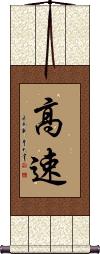
高速 means “high speed” or “in high gear” in Chinese and Japanese Kanji.
In old Korean Hanja, it also means “high speed” but can also be a nickname for “rapid transit.”
高速 is the best selection if you want to say “speed” in regard to your race car, race boat, or lifestyle. You need this word, which literally means “high speed,” as the Asian word for “speed” alone does not suggest whether you mean fast or slow.
Holy Mother / Saint Mary
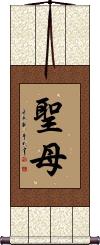
聖母 is the title for the Holy Mother, Madonna, or Virgin Mary used by Catholic Chinese, Korean, and Japanese people.
I think this would be a very cool wall scroll for a devout Catholic who also appreciates Asian artwork and language.
Note: Koreans often put a third character after these two, which creates a title that means “Hail Mary”; however, this character is not added or used in the same way in Japanese or Chinese. If you want that Korean title, just let me know, and we'll add that character for you. The two-character title shown to the left is universal, so I think it's the best choice.
Honesty
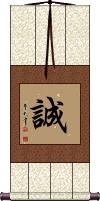
誠 means truth, faith, fidelity, sincerity, trust, and/or confidence.
As a single-character wall scroll, this suggests that you believe “honesty is the best policy,” as your personal philosophy.
This is also a virtue of the Samurai Warrior
See our page with just Code of the Samurai / Bushido here
Honesty / Fidelity
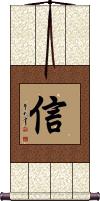
信 is another character that expresses the idea of honesty.
It can also mean truth, faith, belief in, fidelity, sincerity, trust, and/or confidence.
Some have included this in the list for the Bushido, although “makoto” is probably more common/popular.
Note: In some contexts, this character can mean a letter (mail), news, or envoy. However, alone, it will generally be read with the honesty-meaning.
See our page with just Code of the Samurai / Bushido here
See Also: Loyalty Trustworthiness Trustworthy
Honor and Integrity
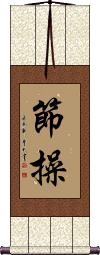
節操 means honorable, integrity of principle, constancy, honor, and in a certain context, chastity.
Please note that there are a few ways to relay the idea of integrity in Asian languages and more than one way to define honor in English. 節操 is far from the only way to express “honor and integrity.”
Honor
(Modern Japanese version)
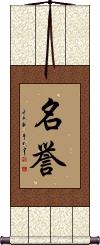
名譽 is a version of honor that is about having or earning the respect of others and about your reputation.
It is the status of being worthy of honor (not to be confused with doing honorable things or specific actions - see our other “honor” listing for that).
 Both modern Japanese and modern mainland Chinese use the same simplified version of the second character of honor. You can make a special request for the traditional second character as shown to the right (just click on that character to the right of you want to order that version). Before WWII, both Japan and China used the traditional form but modern Japanese and Chinese use this simplified form. Koreans still use the traditional form when they are not writing in their modern Hangul glyphs.
This is also a virtue of the Samurai Warrior
See our page with just Code of the Samurai / Bushido here
Achieve Inner Peace; Find Deep Understanding
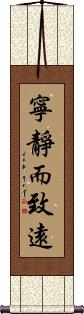
寧靜而致遠 is five characters from a longer ten-character proverb composed by Zhuge Liang about 1800 years ago.
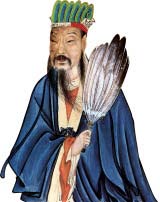
诸葛亮 Zhuge Liang
The proverb means “Your inner peace/tranquility/serenity will help you see or reach far (into the world).”
The last word means “far” but the deeper meaning is that you will surpass what you can currently see or understand. Perhaps even opening up vast knowledge and understanding of complex ideas.
Jackie Chan
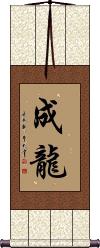
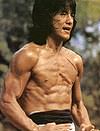 成龍 is the Chinese and Japanese stage name of Jackie Chan, a Kung Fu film and Cantonese pop star icon.
His birth name was 陳港生 (romanized as Chan Kong-sang or Can Gong-sang in Cantonese, or Chén Gǎng-shēng in Mandarin.
Joshua 24:15
This House Serves the LORD
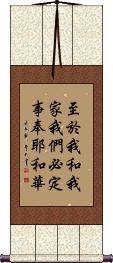
至於我和我家我們必定事奉耶和華 is the last sentence of Joshua 24:15 in Chinese.
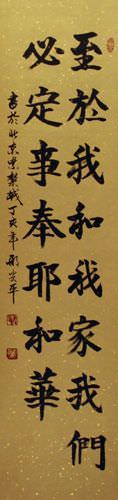
What your
calligraphy
might look like
from our
Chinese Master
Calligrapher
Joshua 24:15 (KJV) ...as for me and my house, we will serve the LORD.
Joshua 24:15 (NIV) ...as for me and my household, we will serve the LORD.
We used the only official Christian Chinese Bible that I know of so that the translation would be as accurate and standard as possible. Any Chinese Christian worth their salt will easily be able to identify this verse from the Chinese words on this scroll.
I think it is a bit like having a secret code on your wall that quietly expresses to whom you are faithful.
A great gift for your devout Christian or Jewish friend if they happen to be fond of Asian art.
Or perhaps a wonderful “conversation starter” for your own home.
Note: If you are curious, the last three characters represent the way “LORD” is used in most English Bibles. In Chinese, this is actually the phonetic name from Mandarin Chinese for “Jehovah.”
Joshua 24:15
This House Serves the LORD
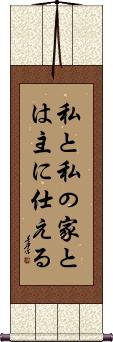
私と私の家とは、主に仕える is the last bit of Joshua 24:15 in Japanese.
Joshua 24:15 (KJV) ...as for me and my house, we will serve the LORD.
Joshua 24:15 (NIV) ...as for me and my household, we will serve the LORD.
This came from the Shinkaiyaku Japanese Bible. This is the most commonly-used Bible translation in Japan for both Protestants and Catholic Japanese folks.
I think it is a bit like having a secret code on your wall that quietly expresses to whom you are faithful.
This will be a nice gift for a friend or a wonderful expression of faith for your own home.
Note: Because this selection contains some special Japanese Hiragana characters, it should be written by a Japanese calligrapher.
Jujitsu / Jujutsu
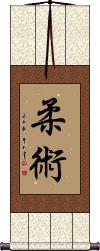
柔術 has been somewhat incorrectly spelled and pronounced “Jujitsu” for some time in the English-speaking world. The correct Japanese Romaji is Jujutsu or Juujutsu.
A little background on the word: By combining the Kanji pronounced “Ju” (which means flexible, pliable, gentle, yielding) with the Kanji pronounced “Jutsu” (which means art or technique), we get a meaning that can be translated as “flexible technique,” “gentle art” or “yielding technique.”
柔術 does make sense in Chinese as well, although pronounced “rou shu” in China.
The Jujutsu system has a history in Japan that started well before the 1600s. Some see this style as a variation of the “Empty Hand Method” (Karate-do). Even the samurai of old used some Jujutsu methods in defending themselves with their unarmed hands against weapons that could pierce their heavy armor.
There are convoluted relationships between various schools and systems of martial arts, but it's generally accepted that Jujutsu led to the development of Judo and a few other variations.
Justice / Rectitude / Right Decision
Also means: honor loyalty morality righteousness
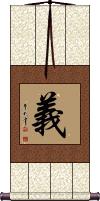
義 is about doing the right thing or making the right decision, not because it's easy but because it's ethically and morally correct.
No matter the outcome or result, one does not lose face if tempering proper justice.
義 can also be defined as righteousness, justice, morality, honor, or “right conduct.” In a more expanded definition, it can mean loyalty to friends, loyalty to the public good, or patriotism. This idea of loyalty and friendship comes from the fact that you will treat those you are loyal to with morality and justice.
義 is also one of the five tenets of Confucius's doctrine.
 There's also an alternate version of this character sometimes seen in Bushido or Korean Taekwondo tenets. It's just the addition of a radical on the left side of the character. If you want this version, click on the image to the right instead of the button above.
This is also a virtue of the Samurai Warrior
See our page with just Code of the Samurai / Bushido here
See Also: Judgment | Impartial | Confucius Tenets
Kana
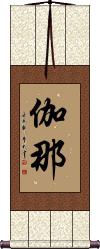
This is a Japanese female given name that romanizes as Kana.
This can also be the Asian names gana or ghana in Buddhist context. The meaning can be close, solid, or thick.
Karma (of your past lives)
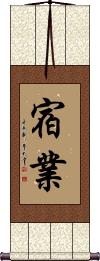
宿業 is the Buddhist concept of Past Karma. Simply put, it's the sum of all the good and bad from all previous lives (perhaps earlier in your current life). This term is not commonly used outside of the Buddhist faith (you'll have a tough time finding a non-Buddhist Asian person that knows this word).
Other ways to translate this are “The karma of previous existence,” “The karma remaining from prior existences,” or simply “Former karma.”
See Also: Buddhism
Katana
Japanese Samurai Sword
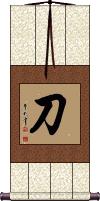
刀 is the Japanese Kanji for “sword.” This refers to the style of sword carried by warriors, samurai, and shogun of ancient Japan.
With the pacification of Japan, such swords are now only used for ceremony and decoration. The true art of sword-smithing is all but lost in Japan with new sword production dedicated to making inexpensive replicas for the tourist and foreign market.
For those of you that want to ask whether I can get you a real antique sword. Let me tell you that most real Asian swords were melted down after WWII in Japan, and during the Great Leap Forward in China. Any remaining swords are family heirlooms that nobody will part with.
Please carefully note that the Japanese kanji character shown above is only for a Japanese audience. In China, this character means “knife.” See our other entry for “sword” in Chinese.
Note: 刀 can mean knife, sword, or blade in Korean, depending on context.
See Also: Sword
Kenjutsu / Kenjitsu
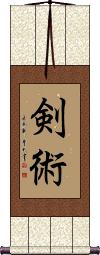
In Japanese, the modern definition, using simple terms, 剣術 is “A martial art involving swords” or “The art of the sword.”
However, in Chinese, this is the word for fencing (as in the Olympic sport).
I will suppose that you want this for the Japanese definition, which comes from skills and techniques developed in the 15th century. At that time, Kenjutsu (or swordsmanship) was a strictly military art taught to Samurai and Bushi (soldiers). The fact that swords are rarely used in military battles anymore, and with the pacification of Japan after WWII, Kenjutsu is strictly a ceremonial practice often studied as a form of martial art (more for the discipline aspect rather than practical purpose).
Language note: The Korean definition is close to the Japanese version described above. However, it should be noted that this can mean “fencing” depending on the context in Japanese, Chinese, and Korean.

 Character variation notes: There are slight variations possible with the second character. Either way is correct and understood by both Japanese and Chinese folks.
Since there are about 5 common ways to write the sword character, if you are particular about which version you want, please note that in the “special instructions” when you place your order.
Romanization note: This term is often Romanized as Kenjitsu; however, following the rules of Japanese Romaji, it should be Kenjutsu.
King
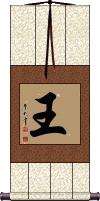
王 is wang which means king. It is not pronounced the way you think in Chinese. It is more like English speakers would want to pronounce wong. It has roughly the same vowel sound as tong, song, or long in English.
Note that this means king only, not the emperor. An emperor is higher than a king, and theoretically is chosen by God, according to ancient Chinese culture. However, the definition is often blurred at various points in Asian history.
王 can also be defined as ruler, sovereign, monarch, or magnate. It is also can refer to a game piece in the chess-like Japanese strategic game of shoji.
Note: This can also be a family name in Chinese, Korean and Vietnamese (in Vietnamese it's Vương).
See Also: Queen
Kirin / Giraffe / Mythical Creature
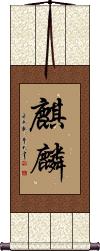
麒麟 is the title of a mythical beast of Asia.
The animal is thought to be related to the giraffe, and in some ways, it is a giraffe. However, it is often depicted with the horns of a dragon or deer and sometimes with the body like a horse, but many variations exist.
In Japanese, it is pronounced “Kirin” as in “Kirin Ichiban” beer.

Notes:
1. This is sometimes spelled as “kylin.”
2. In Japanese, this is the only Kanji word for giraffe. Therefore in Japan, this word needs context to know whether you are talking about the mythical creature or the long-necked giraffe of Africa.
3. Apparently, this was the first word used for regular giraffes in China (some were brought from Africa to China during the Ming Dynasty - probably around the year 1400). Though the mythical creature may have existed before, the name “qilin” was given to the “new giraffe.” This is because, more than 600 years ago, giraffes somewhat matched the mythical creature's description when Chinese people saw them for the first time. Later, to avoid such an ambiguous title, a three-character word was devised to mean a “giraffe of Africa.” The characters for “qilin” shown here are only for the mythological version in modern Chinese.
4. More information about the qilin / kirin from Wikipedia.
5. This creature is sometimes translated as the “Chinese Unicorn,” although it is generally portrayed with two horns. I think this is done more for the fantasy aspect of the unicorn and because most westerners don't know what a qilin or kirin is (this avoids a long explanation by the translator).
6. In Korean, this can mean kirin or simply giraffe (usually, the mythological creature is what they would think of when seeing these characters alone on a wall scroll).
Life Energy / Spiritual Energy
Chi Energy: Essence of Life / Energy Flow
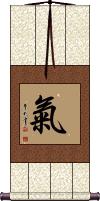
This 氣 energy flow is a fundamental concept of traditional Asian culture.
氣 is romanized as “Qi” or “Chi” in Chinese, “Gi” in Korean, and “Ki” in Japanese.
Chi is believed to be part of everything that exists, as in “life force” or “spiritual energy.” It is most often translated as “energy flow” or literally as “air” or “breath.” Some people will simply translate this as “spirit,” but you must consider the kind of spirit we're talking about. I think this is weighted more toward energy than spirit.
The character itself is a representation of steam (or breath) rising from rice. To clarify, the character for rice looks like this: 
Steam was apparently seen as visual evidence of the release of “life energy” when this concept was first developed. The Qi / Chi / Ki character is still used in compound words to mean steam or vapor.
The etymology of this character is a bit complicated. It's suggested that the first form of this character from bronze script (about 2500 years ago) looked like these samples: 

However, it was easy to confuse this with the character for the number three. So the rice radical was added by 221 B.C. (the exact time of this change is debated). This first version with the rice radical looks like this: 
The idea of Qi / Chi / Ki is really a philosophical concept. It's often used to refer to the “flow” of metaphysical energy that sustains living beings. Yet there is much debate that has continued for thousands of years as to whether Qi / Chi / Ki is pure energy or consists partially or fully of matter.
You can also see the character for Qi / Chi / Ki in common compound words such as Tai Chi / Tai Qi, Aikido, Reiki, and Qi Gong / Chi Kung.
In the modern Japanese Kanji, the rice radical has been changed into two strokes that form an X.
The original and traditional Chinese form is still understood in Japanese, but we can also offer that modern Kanji form in our custom calligraphy. If you want this Japanese Kanji, please click on the character to the right instead of the “Select and Customize” button above.
More language notes: This is pronounced like “chee” in Mandarin Chinese, and like “key” in Japanese.
This is also the same way to write this in Korean Hanja where it is Romanized as “gi” and pronounced like “gee” but with a real G-sound, not a J-sound.
Though Vietnamese no longer use Chinese characters in their daily language, this character is still widely known in Vietnam.
See Also: Energy | Life Force | Vitality | Life | Birth | Soul
Life Of A Samurai

The 12th century phrase, 一所懸命 (Issho Kenmei) is often referred to as “Life Of A Samurai.”
Breaking it down:
一 = one
所 = place
懸 = devote
命 = life
一所懸命 literally means “to stake your life on one place.” Today, Japanese people use it to mean giving your full effort to something.
Other translations of 一所懸命 include: Very hard, with utmost effort, as hard as one can, with all one's might, for dear life, eagerly, and/or desperately.
In the context of the Samurai, it is devoting oneself to the defense of one's territory.
Originally 一生懸命 meaning “to stake your life on one birth.”
Listen to Both Sides and be Enlightened, Listen to One Side and be in the Dark
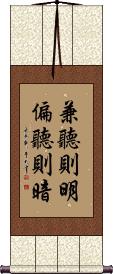
兼聽則明偏聽則暗 is an ancient Chinese proverb about getting all the information from all sides so that you truly understand a situation.
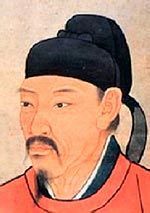
Wei Zheng
A man named Wei Zheng lived between 580-643 AD. He was a noble and wise historian and minister in the court of the early Tang Dynasty. The emperor once asked him, “What should an emperor do to understand the real-world situation, and what makes an emperor out-of-touch with reality?”
Wei Zheng replied, “Listen to both sides and you will be enlightened; listen to only one side and you will be left in the dark.”
Then Wei Zheng went on to cite examples of leaders in history that were victorious after heeding both sides of the story, and other leaders that met their doom because they believed one-sided stories which often came from flattering lips.
Please note that there is an unwritten rule when the same character appears twice in the same phrase, the calligrapher will alter the appearance so that no two characters are exactly alike in the same piece. This calligraphy has two repeating characters that will be written differently than they appear here.
Live Laugh Love
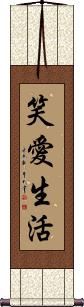
In English, the word order shown in the title is the most natural or popular. In Chinese, the natural order is a little different:
The first character means laugh (sometimes means smile).
The second character means love.
The last two characters mean “live” as in “to be alive” or “pursue life.”
Please note: 笑愛生活 is not a normal phrase in that it does not have a subject, verb, or object. It is a word list. Word lists are not common in Asian languages/grammar (at least not as normal as in English). We only added this entry because so many people requested it.
We put the characters in the order shown above, as it almost makes a single word with the meaning “A life of laughter and love.” It's a made-up word, but it sounds good in Chinese.
We removed the Japanese pronunciation guide from this entry, as the professional Japanese translator deemed it "near nonsense" from a Japanese perspective. Choose this only if your audience is Chinese and you want the fewest-possible characters to express this idea.
In Korean, this would be 소애생활 or "so ae saeng hwar" but I have not confirmed that this makes sense in Korean.
Lost / Dazed and Confused
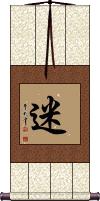
迷 is one of those characters that can mean a lot of different things depending on context. When written alone, as a single character on a wall scroll, it opens up the possibilities and allows you to decide what it means to you.
The key definition is “to be lost.” This could be physically or mentally lost. It can be someone lost in their thoughts, lost in an ocean, or just confused about where they are. The reason for the confused state may be due to internal or external reasons.
Here are some entries from various Asian dictionaries...
Chinese: lost, confused, bewilder, crazy about, fan, enthusiast, mystery.
Japanese: lost, astray, perplexed, in doubt, err, illusion.
Korean: lost, bewildered, fascinated, deluded.
Love
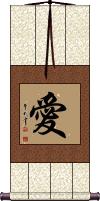
愛 universally means love in Chinese, Japanese Kanji, old Korean Hanja, and old Vietnamese.
愛 is one of the most recognized Asian symbols in the West and is often seen on tee shirts, coffee mugs, tattoos, and more.
愛 can also be defined as affection, to be fond of, to like, or to be keen on. It often refers to romantic love, and is found in phrases like, “I love you.” But in Chinese, one can say, “I love that movie” using this character as well.
This can also be a pet name or part of a pet name in the way we say “dear” or “honey” in English.
This can be a girl’s name “Ai” in both Chinese and Japanese.
More about this character:
This may be hard to imagine as a westerner but the strokes at the top of this love character symbolize family & marriage.
 The symbol in the middle is a little easier to identify. It is the character for "heart" (it can also mean "mind" or "soul"). I guess you can say that no matter if you are from the East or the West, you must put your heart into your love.
 The strokes at the bottom create a modified character that means "friend" or "friendship."
I suppose you could say that the full meaning of this love character is to love your family, spouse, and friends with all of your heart, since all three elements exist in this character.
See Also: I Love You | Caring | Benevolence | Friendliness | Double Happiness Happy Marriage Wall Scroll
Loyalty
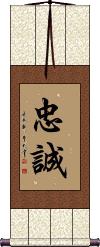
忠誠 is the written form of loyalty that is universal in Chinese, Japanese Kanji, and old Korean Hanja.
Loyalty is staying true to someone. It is standing up for something you believe in without wavering. It is being faithful to your family, country, school, friends, or ideals when the going gets tough and when things are good. With loyalty, you build relationships that last forever.
Notes:
1. There is also a Japanese version that is part of the Bushido Code which may be more desirable depending on whether your intended audience is Japanese or Chinese.
2. This version of loyalty is sometimes translated as devotion, sincerity, fidelity, or allegiance.
Loyalty / Faithful / Devoted
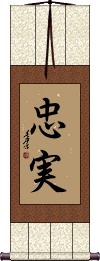
忠実 is a Japanese way to write “Loyalty” - it also contains the ideas of being faithful, devoted, true, and obedient.
The second character is a modified form only used in the Japanese lexicon; however, Chinese speakers can easily guess the meaning.
This is also a virtue of the Samurai Warrior
See our page with just Code of the Samurai / Bushido here
Midori
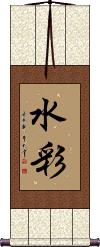
This can be a Japanese female given name that romanizes as Midori. Note: There are other Kanji combinations that romanize as Midori, this is not the only Midori out there.
Otherwise, and in other Asian languages, this means watercolor.
Mind Body Spirit
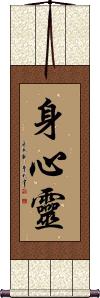
身心靈 is probably the best way to express the idea of “Body, Mind, and Spirit” in Chinese and old Korean Hanja. We are actually using the word “heart” here because, for thousands of years, the heart was thought to be the place where your thoughts, feelings, and emotions came from. We do something similar in the west when we say “warm-hearted” or “I love you with all of my heart.” In this context, heart = mind in Asian language and culture.
The very literal translation of these three characters is “body, heart & spirit,” which could also be interpreted as “body, mind & soul.”
We have arranged these characters in this order because it simply “feels” like the proper order in the Chinese language. Word lists like this are not so common for calligraphy artwork, so we must be careful to put them in the most natural order. It should be noted that this is not a common title in Asia, nor is it considered an actual phrase (as it lacks a clear subject, verb, and object).
 In Japanese Kanji, they use an alternate form of the character for soul or spirit. If you want this using the Japanese alternate, please click on the Kanji shown to the right instead of the button above.
Japanese disclaimer: This is not a natural phrase/list in Japanese. While not totally-natural in Chinese, this word list is best if your audience is Chinese.
Moon
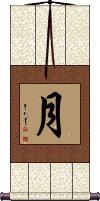
月 is how to write the title for “moon” in Chinese, Korean Hanja, and Japanese Kanji.
月 is also used to refer to the month. This is because China traditionally uses a lunar calendar, so saying “next moon” is the same as saying “next month” etc.
In modern Chinese and Japanese and old Korean, the character for a number is put in front of this moon character to represent western months. So “one moon” is January “two moons” is February etc.
If you are wondering, in the east Asian way to write dates, the character for “sun” or “day” is used with a number in front of it to express the day of the month. So “ten moons, one sun” becomes “October 1st” or “10/1” (this date happens to be Chinese National Day - The equivalent of Independence Day in the USA, Canada Day, or the Queen's Birthday).
In Japanese, 月 can be a surname that romanizes as Tsuki, Tsukizaki, or Takagetsu.
Morera
(second version)
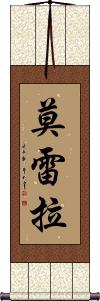
莫雷拉 is another way to transliterate the name Morera.
This version is commonly used but the middle character has an “L” sound instead of an “R.”
These two sounds are often interchanged in Asian languages. It's not a bad transliteration, it just sounds a bit like “Molela” instead of Morera.
Mother and Daughter
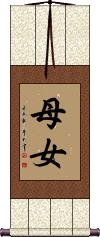
母女 means “mother and daughter” as a unit or as if mother and daughter are a whole together.
母女 is an unusual selection for a calligraphy wall scroll and can be read in many different ways. Your native Asian friends might wonder what you are trying to say. They might even read it as “a mother and daughter without a dad.”
This entry was added to our database for a customer's special request. It has the same meaning in Chinese Characters and Korean Hanja.
See Also: Mother and Son
Musashi
The most famous Samurai
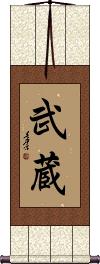
Miyamoto Musashi is probably the most famous Samurai in all of Japanese history.
武蔵 is the short title for a man long in legend. While coming from a lower class, his new sword and fighting techniques put him on par with the best that feudal Japan had to offer. His long career started with his first duel at age 13!
He is credited with using two swords at once and never losing a single battle in his career. After becoming a Buddhist, and getting older, like many old warriors, he took up a peaceful and solitary life until his death around 1645 A.D.
Note: Technically, Musashi is his given name, and Miyamoto is his surname. However, it's suggested that he assumed both of these names and had a few other names in childhood, as well as being given a Buddhist name. It's hard to know what to call him, as with most Kanji, there are multiple pronunciations. The characters for Musashi can also be pronounced Takezō. But everyone in modern times seems to know him by the name Musashi.
Music
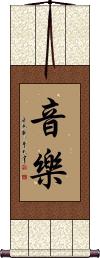
音樂 is how to write music in most Asian languages.
It can also express the idea of a musical movement, depending on context.
 The second character has morphed a bit in Japanese Kanji. If you want the specifically modern Japanese version, please click on the Kanji to the right, instead of the button above. The version shown to the left was used in ancient Japan, prior to the Japanese language reformations after WWII (so technically,
it’s
still Japanese).
The second character has morphed a bit in Japanese Kanji. If you want the specifically modern Japanese version, please click on the Kanji to the right, instead of the button above. The version shown to the left was used in ancient Japan, prior to the Japanese language reformations after WWII (so technically,
it’s
still Japanese).
Musician
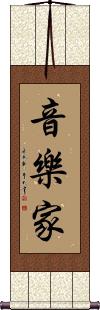
音樂家 is how to write “musician” in most Asian languages.
There is more than one way to express “musician” in China, but this is the traditional and most respectful title.
The second character has morphed a bit in Japanese Kanji. If you want the specifically modern Japanese version, please click on the Kanji to the right, instead of the button above. The version shown to the left was used in ancient Japan, prior to the Japanese language reformations after WWII (so technically,
it’s
still Japanese).
Naginata / Halberd
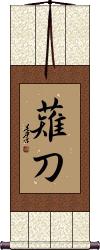
薙刀 is the Japanese word naginata.
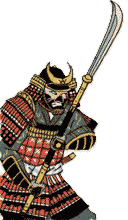 A naginata is a special kind of halberd or long sword carried by some Samurai and other warriors. It is still used ceremonially in some schools of martial arts.
Naranu Koto Wa Naranu Mono Desu
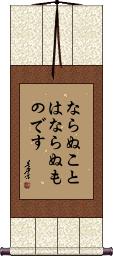
This is a Japanese proverb associated with Bushido that means “What is wrong, must not be done” or “That which must not be shall not be.”
Note: Because this title is entirely Japanese Hiragana, it should be written by a Japanese calligrapher.
Nashi
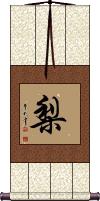
This Japanese Kanji means pear.
This refers specifically to the Pyrus pyrifolia and more specifically the culta variety. This is also known as the Japanese pear, Asian pear, sand pear, or apple pear.
梨 is also a female given name or surname in Japan that beyond Nashi, can be romanized as Rin, Rika, Ri, Nashisaki, or Shina.
In Chinese, this is pronounced like lee or li and just means pear.
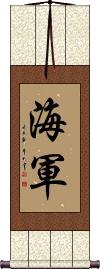
海軍 is the Chinese, Japanese Kanji, and Korean Hanja word for “Navy.” 海軍 is not country-specific, so it is the title for “naval service” from any country with a navy.
These two characters literally mean “sea military.”
A nice scroll for any sailor who likes Asian characters and has pride in their service.
Ninja
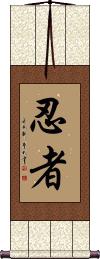
In feudal Japan, ninjas or shinobi (literally, “one who is concealed” or “one that endures”) were sometimes assassins and agents of espionage. The ninja, like samurai, followed their special code of conduct.
The role of the ninja has been romanticized in many American movies (and to a lesser extent in Japanese movies). Because the ninja craze has taken off in the west, Japan has followed the trend, and you'll see plenty of ninja-related imagery in Japan. Note that when writing this as Kanji, Japanese tend to write the first character in the form shown to the right. If you select a Japanese calligrapher, please expect that form. Our Chinese calligraphers can also write it in Japanese form, but only if you request it (in the special instructions about your order during checkout).
Opera
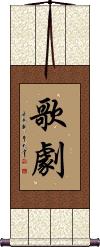
歌劇 is the Chinese, Japanese Kanji, and old Korean Hanja for opera.
This term applies in almost all cases to western opera versus Asian operas or musical plays.
Peace / Harmony
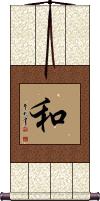
和 is the simplest form of peace and harmony.
和 can also be translated as the peaceful ideas of gentle, mild, kind, and calm. With a more harmonious context, it can be translated as union, together with, on good terms with, or on friendly terms.
Most people would just translate this character as peace and/or harmony. 和 is a very popular character in Asian cultures - you can even call it the “peace symbol” of Asia. In fact, this peace and harmony character was seen repeatedly during the opening ceremony of the 2008 Olympic Games in Beijing (a major theme of the games).
In old Chinese poems and literature, you might see this used as a kind of "and." As in two things summed together. As much as you could say, "the sun and moon," you could say "the sun in harmony with the moon."
See Also: Inner Peace | Patience | Simplicity
Peaceful Warrior
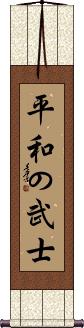
平和の武士 can be read as “Peaceful Warrior” or “Warrior for Peace” in Japanese. This sounds like an oxymoron in Japanese, so it's a weird title. Expect Japanese people to be perplexed when they see it.
Character breakdown:
平和 (heiwa) peace; harmony.
の (no) possessive particle.
武士 (bushi) warrior; samurai; soldier.
Phenomenon
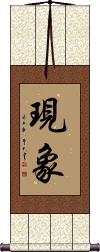
I must first say that 現象 is an odd thing to put on a wall scroll in Asian cultures. It won't make a lot of sense alone unless you have a special or personal meaning that you attach to it for yourself.
These two characters mean phenomenon in Chinese, Japanese, and Korean Hanja. They can also be translated as “a happening,” depending on context.
The sum of these characters is a little different than their individual meanings. But I will break it down anyway...
The first character means present, existing, actual, apparent, now, or current.
The second character alone means pattern after, imitate, image, shape, sign (of the times), form, appearance, to be like, to resemble, to take after, to seem, or elephant.
Mantis / Praying Mantis
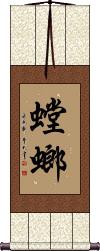
螳螂 is mantis or “praying mantis,” as it's often titled in English.
Technically speaking, this especially applies to the narrow-winged mantis (Tenodera angustipennis)
It is best to use this very common two-character Asian title for the mantis, as the second character alone can mean mantis or dragonfly (totally ambiguous).
This title is antiquated in Japanese, as they tend to write カマキリ (kama kiri) in Katakana to mean praying mantis.
 Note: There is an alternate form of this title which uses the character shown to the right instead of the first character shown above. This is uncommon in both Japan and China (if you really want it anyway, please let us know).
Purple / Violet
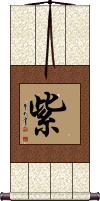
紫 is the single-character Chinese, Japanese, and old Korean title for the color violet/purple.
The difference between violet and purple is not really distinguished in Asian languages. However, sometimes a character for “light” is added to the front of this one, which might be closer to the meaning of violet.
Purple / Violet
(2 character version)
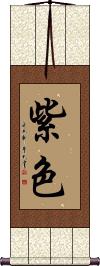
紫色 is the two-character Chinese, Japanese, and old Korean title for the color violet/purple.
The second character means “color,” so this literally means “violet color.”
It's more common to add the “color character” in Asian languages than to say “color” after the name of the color in English. Therefore, this is a natural way to express “violet” in Asian languages.
Rebel / Insurgent
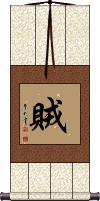
People keep asking me for rebel as a single Chinese character, Korean Hanja, or Japanese Kanji.
The problem is, rebel is not really a good word in Asian culture (depending on the context in which it is used). 賊 is a rebel symbol that can also mean thief; traitor; evil; robber; burglar; insurgent; or a spoiler. Used as an adjective, it can mean wily or deceitful.
This in-stock artwork might be what you are looking for, and ships right away...
Gallery Price: $200.00
Your Price: $118.88

Gallery Price: $200.00
Your Price: $118.88

Gallery Price: $103.00
Your Price: $56.88
Gallery Price: $200.00
Your Price: $98.88

Gallery Price: $200.00
Your Price: $118.88

Gallery Price: $200.00
Your Price: $118.88
Gallery Price: $87.00
Your Price: $47.88

Gallery Price: $200.00
Your Price: $98.88
Gallery Price: $87.00
Your Price: $47.88

Gallery Price: $200.00
Your Price: $98.88
Gallery Price: $200.00
Your Price: $98.88
Gallery Price: $72.00
Your Price: $39.88
Gallery Price: $72.00
Your Price: $39.88



