I am shipping orders on Thursday this week. News and More Info
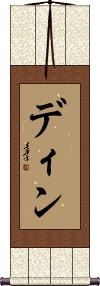
Click the "Customize" button next to your name below to start your personalized din calligraphy artwork...
Switched to secondary search mode due to lack of results using primary.
These secondary results may not be very accurate. Try a different but similar meaning word or phrase for better results. Or...
Look up Din in my Japanese Kanji & Chinese Character Dictionary(My dictionary is a different system then the calligraphy search you just tried)
If you want a special phrase, word, title, name, or proverb, feel free to contact me, and I will translate your custom calligraphy idea for you.
1. 1. Right Understanding / Right Perspective / Right View / Perfect View
2. Addington
3. Adin
4. Adina
5. Adine
6. Aladdin
7. Aldin
8. Amandine
9. Amanudin
10. Amedine
11. Andino
12. Ardini
13. Auddin
14. Baderldin
15. Beaudine
16. Bernadine
17. Bernardina
18. Bernardine
19. Bernardino
20. Blandine
21. Brendin
22. Calamondin
23. Cardinals
24. Claudina
25. Claudine
26. Din
27. Dina
28. Dinah
29. Dinaluz
30. Dinara
31. Dinda
32. Dinero
33. Dinesh
34. Ding / Cho
35. Dinh
36. Dinio
37. Dinis
38. Dinisia
39. Dinnie
40. Dino
41. Dinorah
42. Dinosaur
43. Enedina
45. Ferdinand
46. Four Noble Truths: Path Leading Away From Suffering
47. Geraldine
48. Gerardine
49. Godinez
50. 50th Golden Wedding Anniversary
51. Hiding in the Leaves - Hagakure
52. Holding Flowers with Subtle Smile
54. A Life of Serenity Yields Understanding
55. Achieve Inner Peace; Find Deep Understanding
56. Jamaluddin
Samyag Dristhi / Samyag Drsti / Samma Ditthi
正見 is one of the Noble Eightfold Paths of Buddhism. Right View, along with the Right Thought, constitutes the path to Wisdom.
To get to the correct view of the world, you must first understand and follow Four Noble Truths.
Note: This term is exclusively used by devout Buddhists. It is not a common term, and is remains an unknown concept to most Japanese and Chinese people.
See Also: Buddhism | Enlightenment | Noble Eightfold Path
Surname
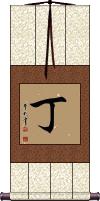
丁 is the Mandarin Chinese surname Ding.
In Japanese, 丁 can be surnames that romanize as Chō or Chou. It can also be more unusual Japanese surnames Rei, Yoroi, Yoboro, Youro, Momoki, Hinoto, Tei, Chiyon, Choudei, Chiyun, or Jiyon.
丁 can refer to nails or pieces of something. It is also a counter for long thin objects like scissors, spades, hoes, inksticks, palanquins, candles, etc.
恐龍 is the Chinese, Japanese Kanji, and old Korean Hanja title for dinosaurs.
In Chinese, this is sometimes used as slang for an ugly person.
In modern Japan, they write the second Kanji as 竜 instead of 龍.
It has the same meaning and pronunciation, but if you want the Japanese version of dinosaur, please click on the image to the right instead of the button above.
Magga
道諦 is the idea that once you have dealt with your desires and left all desire and attachment behind, only then are you on the path away from suffering (and on your way to enlightenment).
道諦 is also called the path to liberation in some English texts on Buddhism.
This term is exclusively used by devout Buddhists. It is not a common term, and is remains an unknown concept to most Chinese, Japanese and Korean people.
See Also: Buddhism | Enlightenment
幸福金婚 means “Happy Golden Anniversary” and is a great gift for a couple who is celebrating 50 years together.
The first two characters mean happy, blessed, or happiness.
The last two characters mean “couple's golden anniversary.” It means “golden wedding” or “golden marriage,” but this is only used for the 50-year-mark of a marriage (the same way we use gold to represent 50 years in the west).
幸福金婚 is a nice title to use with an inscription. You could request something like, “Happy 50th Anniversary, Mr. and Mrs. Smith,” to be written down the side of this title in smaller Chinese characters.
Please note: This can be pronounced and understood in Japanese but not as commonly used in Japan. Japanese people who read this will understand it but might tend to feel it’s of Chinese origin.
An idiom for heart-to-heart communication
拈華微笑 is a Chinese, Korean, and Japanese Buddhist title that relays the idea of “heart-to-heart communication,” or “thought transference.”
The literal translation is, “holding a flower and subtly smiling,” or “the holding of a flower with a subtle smile.” It is the visual act and emotion that communicates more volume than words can say.
不屈不撓 means “Indomitable” or “Unyielding.”
不屈不撓 is a long word by Chinese standards. At least, it is often translated as a single word into English. It's actually a proverb in Chinese.
If you want to break it down, you can see that the first and third characters are the same. Both mean “not” (they work as a suffix to make a negative or opposite meaning to whatever character follows).
The second character means “bendable.”
The last means “scratched” or “bothered.”
So this really means “Won't be bent, can't be bothered.” I have also seen it written as “Will not crouch, will not submit.” This comes from the fact that the second character can mean “to crouch” and the last can mean “to submit” (as in “to give in” such as “submitting to the rule of someone else”). This may explain better why these four characters mean “indomitable.”
Notes:
Some will translate this as “indomitable spirit”; however, technically, there is no character to suggest the idea of “spirit” in this word.
Other translations include indefatigability, indomitableness, or unremitting tenacity.
The first two characters can be stand-alone words in Chinese.
In Japanese, this is considered two words (with very similar meanings). It's more common to see the word order flipped to 不撓不屈 in Japanese.
The same characters are used in old Korean Hanja. Just like in Japanese, the words are swapped to 不撓不屈 creating a word pronounced “불요불굴” in Korean.
See 不撓不屈
淡泊以明志寧靜而致遠 is a kind of complex ten-character proverb composed by Zhuge Liang about 1800 years ago.
This is a Chinese proverb that means “Leading a simple life will yield a clear mind, and having inner peace will help you see far (into the world).”
What I have translated as “simple life” means NOT being materialistic and NOT competing in the rat race.
The last word means “far” but the deeper meaning is that you will surpass what you can currently see or understand. Perhaps even the idea of opening up vast knowledge and understanding of complex ideas.
The whole phrase has a theme that suggests if you are NOT an aggressive cut-throat person who fights his way to the top no matter how many people he crushes on the way, and instead seek inner peace, you will have a happier existence and be more likely to understand the meaning of life.
See Also: Serenity
寧靜而致遠 is five characters from a longer ten-character proverb composed by Zhuge Liang about 1800 years ago.
诸葛亮 Zhuge Liang
The proverb means “Your inner peace/tranquility/serenity will help you see or reach far (into the world).”
The last word means “far” but the deeper meaning is that you will surpass what you can currently see or understand. Perhaps even opening up vast knowledge and understanding of complex ideas.
All of our calligraphy wall scrolls are handmade.
When the calligrapher finishes creating your artwork, it is taken to my art mounting workshop in Beijing where a wall scroll is made by hand from a combination of silk, rice paper, and wood.
After we create your wall scroll, it takes at least two weeks for air mail delivery from Beijing to you.
Allow a few weeks for delivery. Rush service speeds it up by a week or two for $10!
When you select your calligraphy, you'll be taken to another page where you can choose various custom options.
The wall scroll that Sandy is holding in this picture is a "large size"
single-character wall scroll.
We also offer custom wall scrolls in small, medium, and an even-larger jumbo size.
Professional calligraphers are getting to be hard to find these days.
Instead of drawing characters by hand, the new generation in China merely type roman letters into their computer keyboards and pick the character that they want from a list that pops up.
There is some fear that true Chinese calligraphy may become a lost art in the coming years. Many art institutes in China are now promoting calligraphy programs in hopes of keeping this unique form
of art alive.
Even with the teachings of a top-ranked calligrapher in China, my calligraphy will never be good enough to sell. I will leave that to the experts.
The same calligrapher who gave me those lessons also attracted a crowd of thousands and a TV crew as he created characters over 6-feet high. He happens to be ranked as one of the top 100 calligraphers in all of China. He is also one of very few that would actually attempt such a feat.
Some people may refer to this entry as Din Kanji, Din Characters, Din in Mandarin Chinese, Din Characters, Din in Chinese Writing, Din in Japanese Writing, Din in Asian Writing, Din Ideograms, Chinese Din symbols, Din Hieroglyphics, Din Glyphs, Din in Chinese Letters, Din Hanzi, Din in Japanese Kanji, Din Pictograms, Din in the Chinese Written-Language, or Din in the Japanese Written-Language.