I am shipping orders on Thursday this week. News and More Info
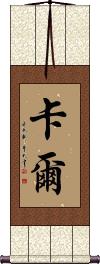
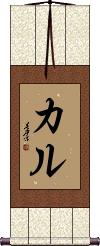
Click the "Customize" button next to your name below to start your personalized cal calligraphy artwork...
Switched to secondary search mode due to lack of results using primary.
These secondary results may not be very accurate. Try a different but similar meaning word or phrase for better results. Or...
Look up Cal in my Japanese Kanji & Chinese Character Dictionary(My dictionary is a different system then the calligraphy search you just tried)
If you want a special phrase, word, title, name, or proverb, feel free to contact me, and I will translate your custom calligraphy idea for you.
1. Acala
2. Alcala
3. Pascal
4. Cal
5. Cala
6. Calamondin
7. Calcarina
8. Cale
9. Caleb
10. Calfee
11. Cali
12. Calicto
13. California
14. Calista
15. Calix
16. Calixto
17. Callaghan
18. Callah
19. Callan
20. Callen
21. Callicutt
22. Callie
23. Calliegrace
24. Calliope
25. Callista
26. Call Of Duty
27. Callum
28. Keep Calm in Face of Adversity
30. Calm / Cool
34. Calob
35. Calum
36. Calvin
37. Calvino
38. Caly
39. Ethics / Ethical / Morality
40. Goncalo
41. Goncalvo
42. Words Have Enormous Weight: One Word Worth Nine Caldrons
43. Keep Calm, Be Not Impatient
44. Kirin / Giraffe / Mythical Creature
45. McCalin
46. McCallister
47. Mccallum
48. McCalmont
49. Metcalf
50. Metcalfe
51. New Caledonia
53. Pacaldo
54. Pascal
55. Pascale
失意泰然 is a very old Japanese proverb that suggests “keeping calm and collected at times of disappointment,” or “maintaining a serene state of mind when faced with adversity.”
It's hard to relate individual character meanings to the overall meaning unless you also understand Japanese grammar. The word order is very different than English. That being said, here's the character meaning breakdown:
失 To miss, lose or fail.
意 Feelings, thoughts, meaning.
泰 Safe, peaceful.
然 Like that, in that way, however, although.
Using these definitions in English, we might say, “Although you may fail or lose, have a feeling of peace and calm.”
鎮靜 represents the idea of being calm, cool, or relaxed in Chinese, Japanese Kanji, and old Korean Hanja.
My Korean dictionary further defines this as quiet, calm, tranquility, and pacification.
From my Japanese dictionary: calm, quiet, tranquility, appeasement, pacification.
Note: This term is also used in Korean Hanja but there is a slight deviation in the way they write the second character in Korean. Still, a Korean person who can read Hanja, will be able to read this word. We can write it in the Korean form if you wish (just let us know when you place your order). In Korean, this is the word you might use to tell someone to "calm down" or "take it easy."
冷靜 means calm and cool-headed in Chinese, Japanese, and Korean.
Other translations: calmness, composure, coolness, serenity, tranquility.
冷靜 is a good wall scroll for someone that wants to remind themselves to stay calm and level-headed.
See Also: Sober Calm
安 is used in a lot of compound words in the CJK world.
Alone, this character has a broad span of possible meanings. These meanings include relaxed, quiet, rested, contented, calm, still, to pacify, peaceful, at peace, soothing, or soothed.
安 and even the pronunciation was borrowed from Chinese and absorbed into both Japanese Kanji and Korean Hanja. In all these languages, this character is pronounced like “an.”
道德 is a Chinese, Japanese, and old Korean word that can also be defined as “moral principles,” morality, ethics, ethical, morals, or virtue.
The first character is the same that is associated with Daoism / Taoism. This word is also used to express morality, virtue, or simply morals.
There is a slight deviation in the Japanese Kanji form. If you want the modern Japanese version, please click on the special Kanji shown to the right instead of the button above. Note that the traditional Chinese form is still readable and understood by Japanese people.
一言九鼎 is an ancient Chinese proverb used in modern times to talk of profound or powerful words.
The literal meaning is “one word [worth] nine [sacred] tripods.” The tripod is a highly-prized three-legged (sometimes four-legged) metal pot or kettle of ancient China. They are often made of bronze, and the Emperor would have large ones gilded in gold. See the image to the right for an example.
麒麟 is the title of a mythical beast of Asia.
The animal is thought to be related to the giraffe, and in some ways, it is a giraffe. However, it is often depicted with the horns of a dragon or deer and sometimes with the body like a horse, but many variations exist.
In Japanese, it is pronounced “Kirin” as in “Kirin Ichiban” beer.

Notes:
1. This is sometimes spelled as “kylin.”
2. In Japanese, this is the only Kanji word for giraffe. Therefore in Japan, this word needs context to know whether you are talking about the mythical creature or the long-necked giraffe of Africa.
3. Apparently, this was the first word used for regular giraffes in China (some were brought from Africa to China during the Ming Dynasty - probably around the year 1400). Though the mythical creature may have existed before, the name “qilin” was given to the “new giraffe.” This is because, more than 600 years ago, giraffes somewhat matched the mythical creature's description when Chinese people saw them for the first time. Later, to avoid such an ambiguous title, a three-character word was devised to mean a “giraffe of Africa.” The characters for “qilin” shown here are only for the mythological version in modern Chinese.
4. More information about the qilin / kirin from Wikipedia.
5. This creature is sometimes translated as the “Chinese Unicorn,” although it is generally portrayed with two horns. I think this is done more for the fantasy aspect of the unicorn and because most westerners don't know what a qilin or kirin is (this avoids a long explanation by the translator).
6. In Korean, this can mean kirin or simply giraffe (usually, the mythological creature is what they would think of when seeing these characters alone on a wall scroll).
This is the Chinese name for the country of New Caledonia (overseas territory of France).
See Also: North America
虛心坦懐 is a Japanese proverb that means “with an open and calm mind,” “with no preconceived notions,” or “without reservations.”
In some contexts, it can mean frank or candid.
If you want to remind yourself to approach each situation with no preconceptions, this is a good title for you. This can also refer to the ideas of being candid, frank, and straightforward.
パスカル is a Japanese Katakana word used to mean pascal (unit of pressure), PASCAL (computer language), or Blaise Pascal, the famous French mathematician.
If your name is Pascal, this is also how to write your name in Japanese.
Note: Because this title is entirely Japanese Katakana, it should be written by a Japanese calligrapher.
All of our calligraphy wall scrolls are handmade.
When the calligrapher finishes creating your artwork, it is taken to my art mounting workshop in Beijing where a wall scroll is made by hand from a combination of silk, rice paper, and wood.
After we create your wall scroll, it takes at least two weeks for air mail delivery from Beijing to you.
Allow a few weeks for delivery. Rush service speeds it up by a week or two for $10!
When you select your calligraphy, you'll be taken to another page where you can choose various custom options.
The wall scroll that Sandy is holding in this picture is a "large size"
single-character wall scroll.
We also offer custom wall scrolls in small, medium, and an even-larger jumbo size.
Professional calligraphers are getting to be hard to find these days.
Instead of drawing characters by hand, the new generation in China merely type roman letters into their computer keyboards and pick the character that they want from a list that pops up.
There is some fear that true Chinese calligraphy may become a lost art in the coming years. Many art institutes in China are now promoting calligraphy programs in hopes of keeping this unique form
of art alive.
Even with the teachings of a top-ranked calligrapher in China, my calligraphy will never be good enough to sell. I will leave that to the experts.
The same calligrapher who gave me those lessons also attracted a crowd of thousands and a TV crew as he created characters over 6-feet high. He happens to be ranked as one of the top 100 calligraphers in all of China. He is also one of very few that would actually attempt such a feat.
Some people may refer to this entry as Cal Kanji, Cal Characters, Cal in Mandarin Chinese, Cal Characters, Cal in Chinese Writing, Cal in Japanese Writing, Cal in Asian Writing, Cal Ideograms, Chinese Cal symbols, Cal Hieroglyphics, Cal Glyphs, Cal in Chinese Letters, Cal Hanzi, Cal in Japanese Kanji, Cal Pictograms, Cal in the Chinese Written-Language, or Cal in the Japanese Written-Language.