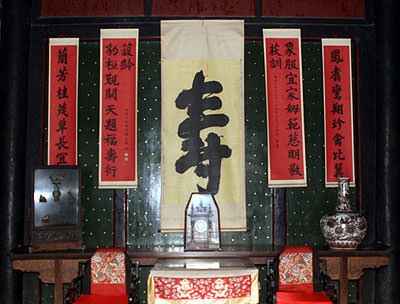
The Name Asian-art/asian-art/essayons.png in Chinese/Japanese on a Personalized Wall Scroll.
Click the "Customize" button next to your name below to start your personalized asian-art/asian-art/essayons.png calligraphy artwork...
Switched to secondary search mode due to lack of results using primary.
These secondary results may not be very accurate. Try a different but similar meaning word or phrase for better results. Or...
Look up in my Japanese Kanji & Chinese Character Dictionary(My dictionary is a different system then the calligraphy search you just tried)
If you want a special phrase, word, title, name, or proverb, feel free to contact me, and I will translate your custom calligraphy idea for you.
2. Animals
3. Appreciation of Truth by Meditation
5. Asian Pride / Oriental Pride / AZN Pryde
6. Bamboo
8. Banzai
9. Beautiful
10. You are always a beauty in your lover’s eyes
11. Beauty Shop / Beauty Salon
13. Big Wave
15. Cobra
16. Do not shed a tear until you see the coffin
17. Community
19. Crisis equals Danger plus Opportunity?
20. Crystal
21. Daisy
22. Dignity / Honor / Sanctity / Integrity
23. Double Happiness Guest Book
26. Easter
27. Amitabha Buddha
28. Enso - Japanese Zen Circle
29. Let Us Try
30. Eye for an eye
31. A Bright Future
32. Flower in the Mirror, Moon on Water
33. Forgive
34. Forgiveness
35. Gem
36. Grace from Heaven / Grace from God
38. Guanxi
39. Gung Ho
40. Heaven
41. Words Have Enormous Weight: One Word Worth Nine Caldrons
42. Speed
45. Achieve Inner Peace; Find Deep Understanding
46. Jackie Chan
47. Joshua 24:15
48. Kana
49. Karma
50. Katana
51. King
52. Kirin / Giraffe / Mythical Creature
53. Life Energy / Spiritual Energy
54. Listen to Both Sides and be Enlightened, Listen to One Side and be in the Dark
55. Live Laugh Love
57. Love
58. Midori
59. Mind Body Spirit
60. Moon
61. Morera
63. Music
64. Musician
66. Nashi
67. Navy
68. Opera
69. Peace / Harmony
70. Phenomenon
72. Purple / Violet
75. Ritsu
76. Rose Flower
77. Sincere Heart
78. Strong / Robust
79. Sunshine
80. Taekwondo
81. Tea
82. Teacher / Master / Old Sage
83. Temperance
84. Taekwondo Tenets / Spirit of Taekwon-do
85. The Holy Trinity
86. Thug Life
88. Vampire
Air / Atmosphere
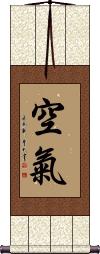
空氣 means air or atmosphere in Chinese, Japanese Kanji, and old Korean Hanja.
This is an unusual title for an Asian calligraphy wall scroll, but many of our western customers have requested it.
 While 空氣 is common in Chinese and Korean Hanja (and ancient Japanese Kanji); please note that in modern Japanese, the second character is written as 気, with slightly fewer strokes. If you want the modern Japanese version, please click on the character to the right. Both versions are understood by native Chinese, Japanese, and many (but not all) Korean people. You should choose the appropriate version based on the intended audience for your calligraphy artwork.
Animals
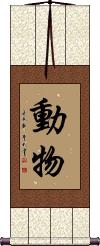
動物 is the way to write “animals” in Chinese characters, Japanese Kanji, and old Korean Hanja.
The first character means “moving,” and the second means “things.”
So animals are “moving things” in these Asian languages.
Appreciation of Truth by Meditation
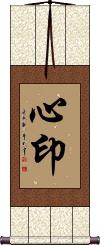
心印 is a Buddhist concept that simply stated is “appreciation of truth by meditation.”
It's a deep subject, but my understanding is that you can find truth through meditation, and once you've found the truth, you can learn to appreciate it more through further meditation. This title is not commonly used outside of the Buddhist community (your Asian friends may or may not understand it). The literal translation would be something like “the mind seal,” I've seen this term translated this way from Japanese Buddhist poetry. But apparently, the seal that is stamped deep in your mind is the truth. You just have to meditate to find it.
Soothill defines it this way: Mental impression, intuitive certainty; the mind is the Buddha-mind in all, which can seal or assure the truth; the term indicates the intuitive method of the Chan (Zen) school, which was independent of the spoken or written word.
Reference: Soothill-Hodous Dictionary of Chinese Buddhism
See Also: Zen
Asia / Asian Continent
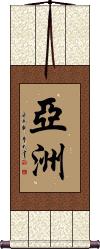
Asia / Asian Continent
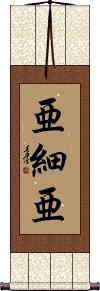
Asian Pride / Oriental Pride / AZN Pryde
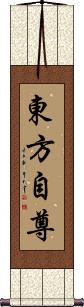
東方自尊 is the universal way to write “Asian Pride.”
We worked on this one for a long time. The effort involved both Chinese and Japanese translators and lengthy discussions. If you have been searching for this term, there is a reason that it's hard to find the way to write “Asian Pride” in Chinese and Japanese - it's because of the inherent difficulties in figuring out a universal combination of characters that can be read in all languages that use forms of Chinese characters.
This final solution that you see to the left creates a reasonable title in Chinese and an exotic (perhaps unusual) title in Japanese (This could be read as “Eastern Self-Respect” in Japanese”).
Although not as natural, it does have the same meaning as Korean Hanja, and the older generation of Vietnamese people will be able to read it.
The first two characters literally mean “Oriental” and the second two mean “pride,” “self-esteem,” or “self-respect” (we chose the most non-arrogant way to say “pride”). If you have “Asian Pride” (sometimes spelled Asian Pryde) these are the characters for you.
Note: For those who wonder, there is nothing technically wrong with the word “Oriental.” It is a correct word, and any bad meanings were created by so-called “Asian Americans” and Caucasians in the United States. To say “Asian” would not completely correct the intended meaning since that would include people from Saudi Arabia, Iraq, Iran, India, and portions of Russia.
For further proof, if you were of East Asian ancestry and born in England, you would be known as a “British Oriental” (The “Oriental stigma” is basically an American creation and, therefore, applies mainly to the American English language - where they get a bit overzealous with political correctness).
Further, since the Chinese and Japanese word for Oriental is not English, they can not be construed as having ill meaning. On one trip to China or Japan, you will find many things titled with these two characters, such as malls, buildings, and business names. These places also use “Oriental” as their English title (much as we do since our Chinese business name starts with these same two characters).
In short, the first two characters have the meaning that Americans attach to “Asian” but is more technically correct.
Bamboo
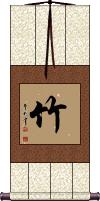
竹 is the character that means bamboo in Chinese, Japanese Kanji, and old Korean Hanja.
In Asian cultures, bamboo is often seen as a symbol of a noble gentleman (tall, straight, and honest).
There are also some multi-character bamboo words that regard individual bamboo plants, species of bamboo, bamboo as lumber, and edible bamboo shoots. However, this single character seems most appropriate for a wall scroll and covers the whole category of Asian bamboo.
Banzai / Wansui
Old Japanese / Traditional Chinese & Korean
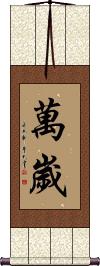
萬歲 is the traditional Chinese, Korean Hanja, and ancient Japanese way of writing banzai.
In modern times, the first character was simplified in Japan and China. So you might want to select the other entry for universal readability.
While it has become a popular, if not an odd, thing to scream as you jump out of an airplane (preferably with a parachute attached), banzai is actually a very old Asian way to say “hooray.” The Japanese word “banzai” comes from the Chinese word “wan sui,” which means “The age of 10,000 years.” It is actually a wish that the Emperor or the Empire live that long.
Imagine long ago when the Emperor made a rare public appearance. 萬歲 is what all people would yell to their leader in respect.
So if you like it as a hooray, or you want to wish someone that they live for 10,000 years, this is the calligraphy for you.
Other translations include Cheers! (not the drinking kind), hurrah!, long live [name]!, and congratulations!
To other things with banzai in their names, I am still waiting for the promised sequel to Buckaroo Banzai.
Notes: Sometimes people confuse banzai with bonsai. A bonsai is a miniature tree. They have nothing to do with each other.
Banzai
Modern Japanese Version
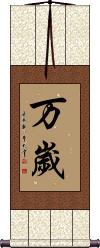
万歲 is the modern Japanese way to write banzai.
We've made two almost identical entries for this word, with just a variation on the first character. In the last century, 萬 was simplified to 万 in Japan and China. The new generation will expect it to be written as 万 but the old generation can still read the more traditional 萬 form. You must make your determination as to what version is best for you. If your audience is mostly Japanese, I suggest 万歲.
While it has become a popular, if not an odd, thing to scream as you jump out of an airplane (preferably with a parachute attached), banzai is actually a very old Asian way to say “hooray.” The Japanese word “banzai” comes from the Chinese word “wan sui” which means “The age of 10,000 years.” It is actually a wish that the Emperor or the Empire live that long.
Imagine long ago when the Emperor made a rare public appearance. This is what all of the people would yell to their leader in respect.
So if you like it as a hooray, or you want to wish someone that they live for 10,000 years, this is the calligraphy for you.
To other things with banzai in their names, I am still waiting for the promised sequel to Buckaroo Banzai.
Other translations: hurrah, long life, congratulations, cheers, live long.
Notes: Sometimes people confuse banzai with bonsai. A bonsai is a miniature tree. They have nothing to do with each other. Further, Bonzai is not a word at all - although it would make a great name for a calcium supplement for older people.
Beautiful
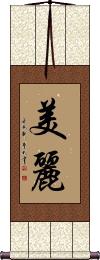
美麗 is a two-character word used often in Chinese, old Korean, and ancient Japanese to express beauty.
I've had a few requests for a “two-character beautiful,” and this is by far the best word. This is not a common word for an Asian person to want on a wall scroll. However, you will see it commonly used as an adjective in phrases, stories, and titles throughout magazines and signage in China.
美麗 can also be translated as gorgeous or lovely.
Note: 美麗 is not commonly used in modern Japan.
You are always a beauty in your lover’s eyes
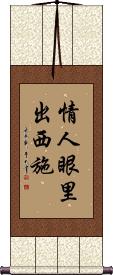
Any woman with affection for Asian art will love a gift of this Chinese proverb calligraphy on a wall scroll.
She will melt in your arms as you tell her the meaning of these characters.
Contained in this phrase is a reference to the most beautiful woman in Chinese history. Her name was Xi Shi, and she was known to have good looks that need not have fine robes or makeup. Her charms were so powerful that she brought down an entire kingdom (in a successful effort to bring honor and pride back to her people).
情人眼里出西施 is a great way to express that the woman in your life is your one love.
Beauty Shop / Beauty Salon
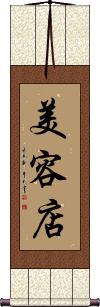
美容店 is how to write “Beauty Shop” or “Beauty Salon.”
If you own such a business, this will make a nice wall scroll to hang up - and many of your Asian customers will be able to read and appreciate it.
When traveling in China, you will see signs like this in the window of any place that offers full services of hair styling, manicures, pedicures, and often shampoo with head and back massage.
However, as a handmade wall scroll, this becomes a very fancy piece of artwork that shows the high class of your business (a great sign for your window if you don't get direct sunlight).
Kindness / Benevolence
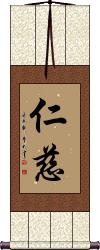
仁慈 word is used in Chinese, Korean, Japanese, and Asian Buddhism to relay the important idea of loving kindness.
仁慈 can also be defined as: benevolent; charitable; kind; merciful; kind-hearted; benevolence; kindness; humanity; mercy.
In Japanese, this can also be the given name Hitoji. This would also be a good Mandarin Chinese given name romanized as Jentzu (in Taiwan) or Renci (which sounds like ren-tsuh).
Big Wave
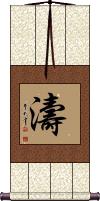
濤 is the Chinese character for “Big Wave.”
It suggests a wave unlike most, strong and powerful.
濤 is technically also a Japanese Kanji, and Korean Hanja but it's not commonly used in those Asian languages. Pronunciation in Japanese and Korean is provided above for reference only. Just order this if your audience is Chinese.
Chong / Sung / Su
Surname
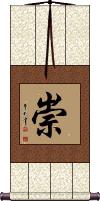
This is the surname “Chong” or “Zhong” in Mandarin Chinese, “Sung” in Cantonese and Korean, and Su in Japanese.
崇 is used in other Chinese words and other Asian languages with the following meanings:
high; sublime; lofty; to esteem; to worship; eminent; honorable; honourable; reverence; adore/adoration.
Cobra
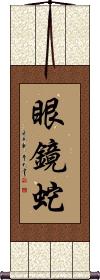
眼鏡蛇 is the Chinese and Japanese Kanji for cobra
This title may refer to the spectacled cobra, Indian cobra, or Asian cobra.
Do not shed a tear until you see the coffin
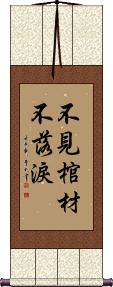
不見棺材不落淚 is a cautionary tale that suggests you are unknowingly (though it should be obvious)on a bad course.
It further suggests that you will not realize your folly until the worst has happened.
This can also be a warning of inaction until it's too late to take action. Again, not realizing your error until it's too late.
In an alternate interpretation, some will suggest this means doing something bad and not looking back - Then the worst happens.
It should be noted that this is one of the oddest selections for a wall scroll in our whole Asian calligraphy database. All of our translators are convinced that no Chinese person would ever hang this on their wall.
Community
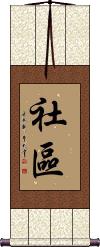
社區 is how to write community in Chinese.
社區 can mean the neighborhood you live in. It can also be used the same way we use the word community in English.
Examples: African-American community, Christian community, Asian community, etc.
If you need a special calligraphy wall scroll to describe your community, just contact me, and I’ll translate it and make it for you.
Crazy / Mad / Wild
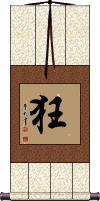
狂 is a single character that means “crazy” in Chinese, Japanese Kanji, and old Korean Hanja.
狂 means crazy, unrestrained, lunatic, insane, confused, deranged, wild, or mad.
This can also refer to an extreme enthusiast (like a football fan). But then, it can also refer to a person possessing a mental abnormality.
In some contexts, this can mean conceited (it probably won't be read that way on a wall scroll).
A warning: 狂 is an odd selection for a wall scroll. You should only order this if you plan to bewilder or confuse those who see it. It kind of says something about you, something that most native Asian people will not view in a good light.
Crisis equals Danger plus Opportunity?
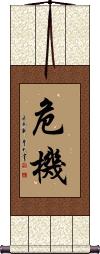
危機 means crisis in Chinese and Japanese.
Separately, the first character here does mean “danger” or “to endanger,” and the second character can mean “opportunity.”
However, I want to debunk a myth that was propagated by some westerners who did not have a clear understanding of Asian languages...
While often, Chinese/Japanese/Korean compound words (words of two or more characters) are the sum of their parts, this is not always the case. The compound is often understood with a completely different meaning than the two characters individually.
Many have said that the Chinese/Japanese/Korean word for Crisis is made up of the characters for “danger” and “opportunity.” 危機 is true when phrased this way.
However, it's not absolutely correct to say that “danger + opportunity = crisis” in Asian cultures.
English example:
If I tell you that...
Bovine creature + Guy behind the plate in baseball = Locomotive train protection

...you would think I was mad. But consider that “cow + catcher = cowcatcher,” which is the device that used to be found on steam engines to protect them if they hit an animal on the tracks. When we hear the word “cowcatcher,” we don't separate the words into their individual meanings (necessarily).
The same is true with the word for crisis in Chinese/Japanese/Korean. While you can separate the characters, few Asian people would automatically do so in their minds.
The final answer:
It is a half-truth to say, “danger plus opportunity equals crisis” in Chinese/Japanese/Korean. Use this statement and concept with caution.
Also, the second character can mean “secret” or “machine,” depending on context so I guess you have to say “a dangerous machine = crisis” or “danger + a secret = crisis.” Both of these are only slightly more ridiculous than the first premise.
PS: 危機 is probably not a great word for a scroll unless you have a special use for it.
Crystal
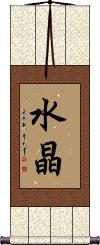
This word means “crystal” such as fine crystal glassware or diamonds in Chinese, Japanese, and Korean Hanja.
水晶 is a cool selection if your name is Crystal, as it will match your name by meaning (rather than pronunciation).
It's also cool because it will universally contain the meaning of your name in most Asian languages.
Daisy
The yellow flower
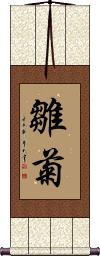
雛菊 is how they write “daisy” in Chinese and Japanese.
This is a good choice if you love daisies, or your name is Daisy. If you translated it directly, this means “chick flower” (as in baby chickens) or “baby chrysanthemum.” Of course, when an Asian person reads this, they just think “daisy.”
If you're into botany, this title represents “Bellis Perennis.”
In Japanese, this can be the female given name, Hinagiku.
Dignity / Honor / Sanctity / Integrity
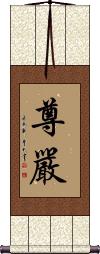
尊嚴 is a form of honor that means showing great respect for yourself, other people, and the rules you live by.
When you are honorable, you keep your word. You do the right thing regardless of what others are doing.
尊嚴 is the kind of personal honor or dignity that is of great value. If you lose this, you have lost yourself and perhaps the reputation of your family as well.
While this is not directly the same thing as “face” or “saving face” in Asian culture, it is associated with the same concept in China.
 In Japan, they currently use a more simplified second character for this word. The ancient Japanese form is the same as China but after WWII some Kanji were changed. If you want the modern Japanese version, just click on the Kanji image shown to the right, instead of the button above.
Double Happiness Guest Book
Customize a special Asian guest book for your wedding
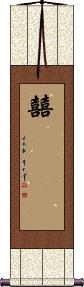
Start customizing a “Double Happiness Guest Book Wall Scroll” Here!
The paper panel length can be whatever you choose from 68cm to 135cm (27” to 53”).
If you don't mention what paper length you want in the special instructions tab (on the next page), we'll make it about 100cm (40”).
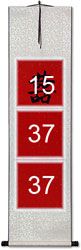
The medium-size scroll with a 33cm x 100cm (13” x 40”) paper panel can usually handle up to 89 signatures. That breaks down to 37 signatures per empty square and 15 signatures around the 囍 character. If you switch to a 135cm paper panel, add another 37 potential signatures.
We can splice two 135cm papers together, but that would be a crazy-long scroll. These are only estimates, your mileage may vary.
With silk panels, this will yield a wall scroll about 155cm (61”) long. That's enough for up to 89 signatures. Of course, that depends on if your guests just sign a brief salutation and name, or more verbose good wishes. Customer feedback is that 126 people can sign the 135cm long paper on a medium-sized scroll. If we go bigger than that, there will be a minor paper seam and an extra charge. Email me with your specifications if you need something special.
Most customers pick the festive red paper with gold flecks and white or ivory silk. Red is a good luck color in Chinese culture, thus the most popular choice. But, you can do any color combination that you want.
There is a long history of Chinese-character-use outside of mainland China. This Double Happiness character is also seen at weddings in Korea, Vietnam, Hong Kong, and Taiwan, as well as in Chinese communities in Thailand, Indonesia, and elsewhere. While Japan borrowed Chinese characters into their language, you won't see 囍 as often at Japanese weddings.
Dragon / Emperor Symbol
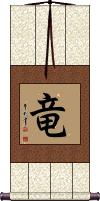
竜 is an alternate form of the dragon.
Still pronounced the same in Chinese, Japanese, and Korean.
This particular Kanji is often associated as an imperial symbol as well as representing the mythical Asian dragon. You may have seen it on the chest or flag of the emperor in old Japanese and Chinese movies.
Note: I would rate this as a non-universal alternate form. The other dragon character is by far more common, and universally understood.
We strongly recommend  if you are looking for the symbol of dragon.
Eagle / Falcon / Hawk
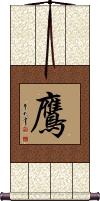
鷹 is the way to write eagle, falcon, or hawk in Chinese.
It means hawk or falcon in Japanese Kanji, and simply “eagle” in old Korean Hanja. Though we have different words for them in English, eagles, falcons, and hawks are all seen as the same general type of bird in Asian languages.
If you are looking for the Dutch surname Valk, or the German surname Falco by meaning, this would be a good character for you.
There are other multi-character words (most of them contain this character) which express different specific species of birds of prey (bald eagle, osprey, golden eagle, etc). If you need a more specific title, just contact me.
Easter
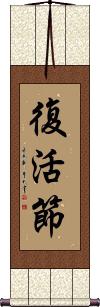
復活節 is the Chinese and old Korean way to write Easter.
Easter is not a well-known holiday in China, but Chinese Christians tend to follow the American tradition of the Easter egg ritual, etc. Non-Christians may think it's a celebration of rabbits that can lay eggs.
South Korea has a higher percentage of Christians than any other Asian country, so they celebrate Easter with plenty of enthusiasm.
Amitabha Buddha
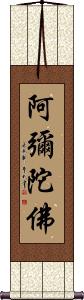
This title can mean the Buddha of the Western paradise.
But it's more a chant that means “May the lord Buddha preserve us!” or “Merciful Buddha!.”
阿彌陀佛 is also a translation to Chinese, Japanese, and Korean for “Amitâbha Buddha.”
Asian Buddhists will often greet and say goodbye to each other with this phrase/chant/title.
Enso - Japanese Zen Circle
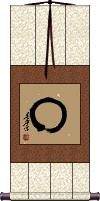
〇 is the famous Enso symbol, which you will see widely used by Japanese Zen Buddhists.
In a twist, I am starting to see Enso used more and more by Chinese Buddhists.
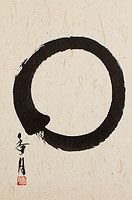
Here is the typical appearance of Enso artwork by Japanese calligrapher Kougetsu.
Enso is not a Japanese Kanji character. It falls more into the category of a symbol. There is some debate, but many consider Enso to be a religious symbol.
Some call this “The Circle of Enlightenment.” Others call it the “Infinity Circle.” If you actually took the meanings of the two Kanji (円相) that make up the word “En-so,” you could read it as “Mutual Circle” or “Circle of Togetherness.” I think the Enso symbol can simply mean different things to different people. Therefore, you should let it have the meaning that you perceive.
The appearance of your Enso will be determined by the artist's personal style, feeling, mood, etc.
Let Us Try
Essayons
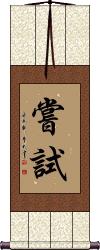
嘗試 is a close match for the English phrase “let us try” or the French word “Essayons.”
 Essayons the motto of Combat Engineers in the U.S. Army.
This word can also be translated as “to try” or “to attempt.”
Even if you're not a Combat Engineer, this word should inspire you to attempt to accomplish difficult things. If you don't try, you are certain to fail; if you do try, at least there is a chance of success.
The worst thing is not failure, the worst thing is not trying at all.
Eye for an eye
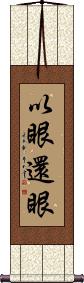
以眼還眼 is the same proverb that seems to be used in virtually every language and culture worldwide.
Whether you are Arab, Persian, Jewish, European, British, Asian, or American, this proverb is well known as the “original form of justice.”
A Bright Future
Incredible 10,000-Mile Flight of the Peng
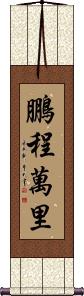
鵬程萬里 is an ancient Chinese proverb used in modern times to wish someone a long and successful career.
It's really about the 10,000 Flight of the Peng (Peng, also known as Roc is a mythical fish that can turn into a bird and take flight).
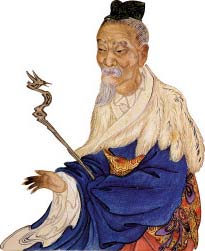
莊子
Zhuangzi or Chuang Tzu
Breaking down each character:
1. Peng or Roc (a kind of bird).
2. Journey (in this case, a flight).
3. 10,000 (Ten Thousand).
4. Li is a unit of distance often referred to as a “Chinese Mile,” though the real distance is about half a kilometer.
Direct Translation: “Peng's Journey [of] 10,000 Li.”
Literal meaning: “The 10,000-Li Flying Range Of The Roc.”
Perceived meaning: “To have a bright future” or “To go far.”
This proverb/idiom comes from the book of Zhuangzi or Chuang Tzu. It tells the tale of a huge fish that could turn into a gigantic bird. This bird was called a “peng” and was many miles long. This legendary size allowed the Peng to fly from the Northern Sea to the Southern Sea in a single bound.
Wishing someone “a Peng's Journey of 10,000 Li” will imply that they can travel far without stopping and will have great success, a long career, and a prosperous future.
Flower in the Mirror, Moon on Water
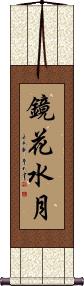
鏡花水月 is an old Asian proverb that means “flowers in a mirror and the moon reflected in the lake” or “flowers reflected on a mirror and the moon reflected on the water's surface.”
Literally, 鏡花水月 reads “Mirror Flower, Water Moon.”
Figuratively this can be used to represent a lot of different ideas. It can be used to express an unrealistic rosy view or viewing things through rose-tinted spectacles. So you can use it to relay an idea about something that is visible but has no substance,
something that can be seen but not touched, or something beautiful but unattainable such as dreams or a mirage.
This expression is used to describe things like the subtle and profound beauty of poems that cannot be described in words.
鏡 = Mirror (or lens)
花 = Flower(s)
水 = Water
月 = Moon
Can also be written 水月鏡花 (just a slight change in word/character order).
Forgive
Deep heartfelt forgiveness
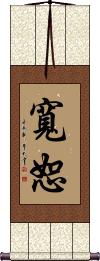
寛恕 is a word of Chinese origin means forgive or forgiveness.
寬恕 is a deep kind of forgiveness from the bottom of your heart.
In a religious context, this is the kind of forgiveness that you beg God for and that God grants you.
In Korean Hanja, this can also be defined as forbearance or leniency.
In Japanese Kanji, beyond forgiveness, this can also mean magnanimity or generosity.
While we don't actively recommend Asian tattoos, this would be the forgiveness title that is best for a tattoo in most cases.
 Note: The first character can also be written in the form shown to the right (especially in Japanese). If you have a preference, please let us know in the "special instructions" when you place your order.
Forgiveness
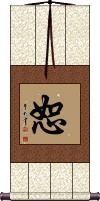
恕 means to forgive, show mercy, absolve, or excuse in Chinese and Korean Hanja (though mostly used in compound words in Korean).
恕 incorporates the pictogram of a heart at the bottom, and a woman and a mouth at the top. The heart portion has the most significance, as it is suggested that it is the heart's nature to forgive.
In Asian culture, as with most other cultures, forgiveness is an act of benevolence and altruism. In forgiving, you put yourself in someone else's shoes and show them the kindness that you would want them to show you. Confucius referred to this quality as “human-heartedness.”
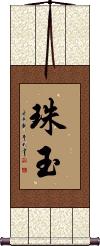
珠玉 is a Chinese, Japanese Kanji, and old Korean Hanja word meaning gem.
Beyond just the word gem, this can refer to pearls and jades, jewels, clever remarks, beautiful writing, gems of wisdom, genius, or an outstanding person.
If your name is Gem, this is a nice way to represent your name in 3 Asian languages. Though the pronunciation will be far from Gem, the meaning of gem is really nice.
Note: In Japanese, this is sometimes used as the female given name, Tama.
Grace from Heaven / Grace from God
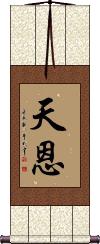
天恩 is the deepest way to say “Heaven's Grace” or “God's Grace” in Chinese.
The first character means Heaven or sky (referring, in this case, to the domain of God).
The second character means grace, blessings, benevolence, favor/favour, acts of kindness, merits, or beneficial influence.
This title can also be defined as:
Blessings of Heaven, Favor of the Emperor, Divination's luckiest day, or blessings of nature. Note: When you see “Emperor” above, remember that the Emperor, like the Pope, is theoretically chosen by God or seen as an emissary or conduit of God in ancient Asian culture. It would only be read that way in a certain context, such as “The Emperor, in his mercy, bestowed upon him Heaven's Grace, and the prisoner was set free.”
Note: Technically, this is a Japanese word too (pronounced "ten-on") but it’s rarely used in Japan anymore. Therefore, this title is best if your audience is Chinese.
Griffin / Gryphon
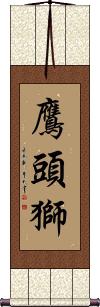
鷹頭獅 is the Chinese title for a Griffin.
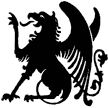 This refers to the legendary creature with the head, talons, and wings of an eagle and the body of a lion. Sometimes also spelled Gryphon or Griffon. From the Greek γρύφων or γρύπων, or Latin Gryphus.
This Chinese title, 鷹頭獅, literally means “Eagle Head Lion.”
Guanxi
The Chinese Concept of Relationship and Exchange of Favors
The dictionary definition is:
Relations/relationship, to concern, to affect, to have to do with, or connection.
But there's more to it...
In China, the relationship that you have with certain people can open doors for you. Having guanxi with someone also means they would never defraud you but are honor-bound to treat you fairly (of course, this goes both ways). Sometimes it is suggested that guanxi is the exchange of favors. 關繫 / 関繫 / 關係 is more about having a relationship that allows you to ask for and expect favors without shame.
There is no concept in western culture that exactly matches guanxi, but perhaps having a social or professional network is similar.
Note that there are some variations common within Chinese, Japanese Kanji, and Korean Hanja for this word... Japanese tend to use a Chinese alternate form as shown to the right for
the first character.
 There's also another alternate form of that first character (currently used as the official Simplified form in mainland China) which looks like the character shown to the right. It's basically the central radical of the alternate version shown above but without the “door radical” around it. In more free-flowing calligraphy styles, this version would be the likely choice for a calligrapher.
 In Modern Japanese, they use the character shown to the right.
They also tend to use this same form in Korean Hanja (I've only checked this word in my Korean dictionary, but it has not been confirmed by a translator's review).
 If that was not confusing enough, there is another alternate form of that second character. See right.
An Asian calligrapher of any nationality may use these forms at their discretion. However, They would tend to stick to the most common form used in their respective languages.
If you have any preference on any of these issues, please give us a special note with your order, and we'll make sure it's done the way you want.
Gung Ho
Working Together
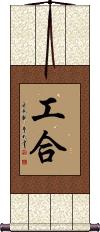
工合 is one of those Asian words that is used more in English than in the original Chinese.
Gung Ho was originally used to speak of Carlson's Raiders, a group of “Gung Ho” U.S. Marines who went on an island-hopping campaign of death during WWII.
A movie called Gung Ho came out in the mid-1940s and was later re-released in the 1950s depicting the 2nd Marine Raider Battalion, and brought this word to the mainstream.
It is still sometimes used today within the U.S. Marine Corps brotherhood to refer to a unit or group that works well together or is otherwise efficient and motivated (has good morals).
In 1986, there was a movie called Gung Ho about a Japanese company taking over an American automotive factory. They completely ignored the fact that this was a Chinese title.
It should be noted that this title actually means a condition, state, manner, or the health of something in Japanese.
Language and pronunciation notes:
Like many Asian words absorbed into common use in English, this one is drastically mispronounced. The official Romanization is “gong he” but that doesn't tell you enough. The vowel sound on the first character is like the English word “own,” now just add the g-sounds to the beginning and end. The second character is misleading, as you might think it is like the English word “he.” In reality, the vowel sound is more like the “u” in “up.”
It should also be noted that the current generation in China no longer uses or recognizes this as a common word or slogan.
Note: This can be pronounced and is a word in Japanese, though seldom used. Japanese will use a variation of "具合" instead. But still, not common.
Heaven
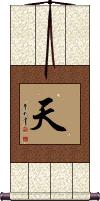
天 means “heaven” or “sky” in Chinese, Japanese Kanji, and old Korean Hanja.
The context determines if you are talking about heaven or the sky above (often they are the same concept).
When combined with other characters, words like “today” and “tomorrow” are created. While sometimes the character for “sun” is used to mean “day,” often “sky” represents “day” in Asian languages.
Example: 今天 (this sky) = “today,” 明天 (next sky) = “tomorrow” in modern Chinese and Japanese.
In Chinese culture, regardless of which religion, it's almost always assumed that God (and any other deities) live up above the sky. The concept of God living in the sky is likely the reason heaven is associated with this character.
The equation goes something like this: God's domain is the sky, thus, the sky is heaven.
Note: As a single character, this is a little ambiguous, so you might want to choose our Kingdom of Heaven selection instead.
Words Have Enormous Weight: One Word Worth Nine Caldrons
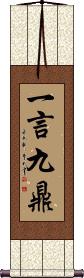
一言九鼎 is an ancient Chinese proverb used in modern times to talk of profound or powerful words.
 The literal meaning is “one word [worth] nine [sacred] tripods.” The tripod is a highly-prized three-legged (sometimes four-legged) metal pot or kettle of ancient China. They are often made of bronze, and the Emperor would have large ones gilded in gold. See the image to the right for an example.
Speed
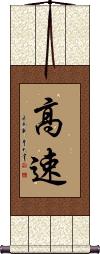
高速 means “high speed” or “in high gear” in Chinese and Japanese Kanji.
In old Korean Hanja, it also means “high speed” but can also be a nickname for “rapid transit.”
高速 is the best selection if you want to say “speed” in regard to your race car, race boat, or lifestyle. You need this word, which literally means “high speed,” as the Asian word for “speed” alone does not suggest whether you mean fast or slow.
Holy Mother / Saint Mary
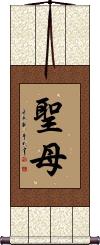
聖母 is the title for the Holy Mother, Madonna, or Virgin Mary used by Catholic Chinese, Korean, and Japanese people.
I think this would be a very cool wall scroll for a devout Catholic who also appreciates Asian artwork and language.
Note: Koreans often put a third character after these two, which creates a title that means “Hail Mary”; however, this character is not added or used in the same way in Japanese or Chinese. If you want that Korean title, just let me know, and we'll add that character for you. The two-character title shown to the left is universal, so I think it's the best choice.
Honor and Integrity
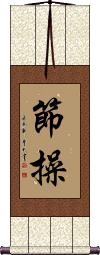
節操 means honorable, integrity of principle, constancy, honor, and in a certain context, chastity.
Please note that there are a few ways to relay the idea of integrity in Asian languages and more than one way to define honor in English. 節操 is far from the only way to express “honor and integrity.”
Achieve Inner Peace; Find Deep Understanding
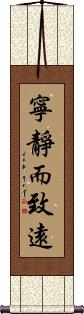
寧靜而致遠 is five characters from a longer ten-character proverb composed by Zhuge Liang about 1800 years ago.
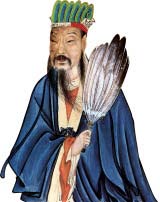
诸葛亮 Zhuge Liang
The proverb means “Your inner peace/tranquility/serenity will help you see or reach far (into the world).”
The last word means “far” but the deeper meaning is that you will surpass what you can currently see or understand. Perhaps even opening up vast knowledge and understanding of complex ideas.
Jackie Chan
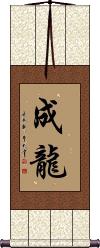
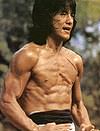 成龍 is the Chinese and Japanese stage name of Jackie Chan, a Kung Fu film and Cantonese pop star icon.
His birth name was 陳港生 (romanized as Chan Kong-sang or Can Gong-sang in Cantonese, or Chén Gǎng-shēng in Mandarin.
Joshua 24:15
This House Serves the LORD
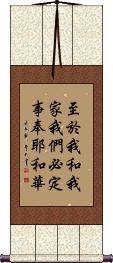
至於我和我家我們必定事奉耶和華 is the last sentence of Joshua 24:15 in Chinese.
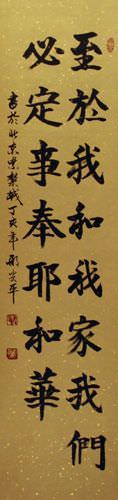
What your
calligraphy
might look like
from our
Chinese Master
Calligrapher
Joshua 24:15 (KJV) ...as for me and my house, we will serve the LORD.
Joshua 24:15 (NIV) ...as for me and my household, we will serve the LORD.
We used the only official Christian Chinese Bible that I know of so that the translation would be as accurate and standard as possible. Any Chinese Christian worth their salt will easily be able to identify this verse from the Chinese words on this scroll.
I think it is a bit like having a secret code on your wall that quietly expresses to whom you are faithful.
A great gift for your devout Christian or Jewish friend if they happen to be fond of Asian art.
Or perhaps a wonderful “conversation starter” for your own home.
Note: If you are curious, the last three characters represent the way “LORD” is used in most English Bibles. In Chinese, this is actually the phonetic name from Mandarin Chinese for “Jehovah.”
Kana
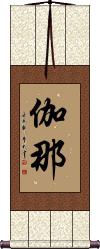
This is a Japanese female given name that romanizes as Kana.
This can also be the Asian names gana or ghana in Buddhist context. The meaning can be close, solid, or thick.
Karma (of your past lives)
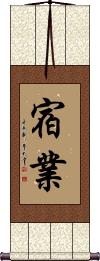
宿業 is the Buddhist concept of Past Karma. Simply put, it's the sum of all the good and bad from all previous lives (perhaps earlier in your current life). This term is not commonly used outside of the Buddhist faith (you'll have a tough time finding a non-Buddhist Asian person that knows this word).
Other ways to translate this are “The karma of previous existence,” “The karma remaining from prior existences,” or simply “Former karma.”
See Also: Buddhism
Katana
Japanese Samurai Sword
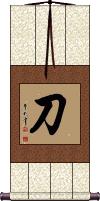
刀 is the Japanese Kanji for “sword.” This refers to the style of sword carried by warriors, samurai, and shogun of ancient Japan.
With the pacification of Japan, such swords are now only used for ceremony and decoration. The true art of sword-smithing is all but lost in Japan with new sword production dedicated to making inexpensive replicas for the tourist and foreign market.
For those of you that want to ask whether I can get you a real antique sword. Let me tell you that most real Asian swords were melted down after WWII in Japan, and during the Great Leap Forward in China. Any remaining swords are family heirlooms that nobody will part with.
Please carefully note that the Japanese kanji character shown above is only for a Japanese audience. In China, this character means “knife.” See our other entry for “sword” in Chinese.
Note: 刀 can mean knife, sword, or blade in Korean, depending on context.
See Also: Sword
King
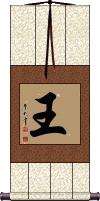
王 is wang which means king. It is not pronounced the way you think in Chinese. It is more like English speakers would want to pronounce wong. It has roughly the same vowel sound as tong, song, or long in English.
Note that this means king only, not the emperor. An emperor is higher than a king, and theoretically is chosen by God, according to ancient Chinese culture. However, the definition is often blurred at various points in Asian history.
王 can also be defined as ruler, sovereign, monarch, or magnate. It is also can refer to a game piece in the chess-like Japanese strategic game of shoji.
Note: This can also be a family name in Chinese, Korean and Vietnamese (in Vietnamese it's Vương).
See Also: Queen
Kirin / Giraffe / Mythical Creature
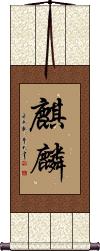
麒麟 is the title of a mythical beast of Asia.
The animal is thought to be related to the giraffe, and in some ways, it is a giraffe. However, it is often depicted with the horns of a dragon or deer and sometimes with the body like a horse, but many variations exist.
In Japanese, it is pronounced “Kirin” as in “Kirin Ichiban” beer.

Notes:
1. This is sometimes spelled as “kylin.”
2. In Japanese, this is the only Kanji word for giraffe. Therefore in Japan, this word needs context to know whether you are talking about the mythical creature or the long-necked giraffe of Africa.
3. Apparently, this was the first word used for regular giraffes in China (some were brought from Africa to China during the Ming Dynasty - probably around the year 1400). Though the mythical creature may have existed before, the name “qilin” was given to the “new giraffe.” This is because, more than 600 years ago, giraffes somewhat matched the mythical creature's description when Chinese people saw them for the first time. Later, to avoid such an ambiguous title, a three-character word was devised to mean a “giraffe of Africa.” The characters for “qilin” shown here are only for the mythological version in modern Chinese.
4. More information about the qilin / kirin from Wikipedia.
5. This creature is sometimes translated as the “Chinese Unicorn,” although it is generally portrayed with two horns. I think this is done more for the fantasy aspect of the unicorn and because most westerners don't know what a qilin or kirin is (this avoids a long explanation by the translator).
6. In Korean, this can mean kirin or simply giraffe (usually, the mythological creature is what they would think of when seeing these characters alone on a wall scroll).
Life Energy / Spiritual Energy
Chi Energy: Essence of Life / Energy Flow
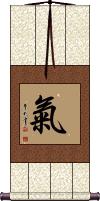
This 氣 energy flow is a fundamental concept of traditional Asian culture.
氣 is romanized as “Qi” or “Chi” in Chinese, “Gi” in Korean, and “Ki” in Japanese.
Chi is believed to be part of everything that exists, as in “life force” or “spiritual energy.” It is most often translated as “energy flow” or literally as “air” or “breath.” Some people will simply translate this as “spirit,” but you must consider the kind of spirit we're talking about. I think this is weighted more toward energy than spirit.
The character itself is a representation of steam (or breath) rising from rice. To clarify, the character for rice looks like this: 
Steam was apparently seen as visual evidence of the release of “life energy” when this concept was first developed. The Qi / Chi / Ki character is still used in compound words to mean steam or vapor.
The etymology of this character is a bit complicated. It's suggested that the first form of this character from bronze script (about 2500 years ago) looked like these samples: 

However, it was easy to confuse this with the character for the number three. So the rice radical was added by 221 B.C. (the exact time of this change is debated). This first version with the rice radical looks like this: 
The idea of Qi / Chi / Ki is really a philosophical concept. It's often used to refer to the “flow” of metaphysical energy that sustains living beings. Yet there is much debate that has continued for thousands of years as to whether Qi / Chi / Ki is pure energy or consists partially or fully of matter.
You can also see the character for Qi / Chi / Ki in common compound words such as Tai Chi / Tai Qi, Aikido, Reiki, and Qi Gong / Chi Kung.
In the modern Japanese Kanji, the rice radical has been changed into two strokes that form an X.
The original and traditional Chinese form is still understood in Japanese, but we can also offer that modern Kanji form in our custom calligraphy. If you want this Japanese Kanji, please click on the character to the right instead of the “Select and Customize” button above.
More language notes: This is pronounced like “chee” in Mandarin Chinese, and like “key” in Japanese.
This is also the same way to write this in Korean Hanja where it is Romanized as “gi” and pronounced like “gee” but with a real G-sound, not a J-sound.
Though Vietnamese no longer use Chinese characters in their daily language, this character is still widely known in Vietnam.
See Also: Energy | Life Force | Vitality | Life | Birth | Soul
Listen to Both Sides and be Enlightened, Listen to One Side and be in the Dark
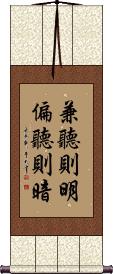
兼聽則明偏聽則暗 is an ancient Chinese proverb about getting all the information from all sides so that you truly understand a situation.
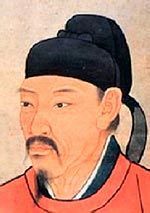
Wei Zheng
A man named Wei Zheng lived between 580-643 AD. He was a noble and wise historian and minister in the court of the early Tang Dynasty. The emperor once asked him, “What should an emperor do to understand the real-world situation, and what makes an emperor out-of-touch with reality?”
Wei Zheng replied, “Listen to both sides and you will be enlightened; listen to only one side and you will be left in the dark.”
Then Wei Zheng went on to cite examples of leaders in history that were victorious after heeding both sides of the story, and other leaders that met their doom because they believed one-sided stories which often came from flattering lips.
Please note that there is an unwritten rule when the same character appears twice in the same phrase, the calligrapher will alter the appearance so that no two characters are exactly alike in the same piece. This calligraphy has two repeating characters that will be written differently than they appear here.
Live Laugh Love
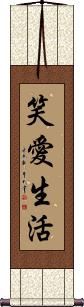
In English, the word order shown in the title is the most natural or popular. In Chinese, the natural order is a little different:
The first character means laugh (sometimes means smile).
The second character means love.
The last two characters mean “live” as in “to be alive” or “pursue life.”
Please note: 笑愛生活 is not a normal phrase in that it does not have a subject, verb, or object. It is a word list. Word lists are not common in Asian languages/grammar (at least not as normal as in English). We only added this entry because so many people requested it.
We put the characters in the order shown above, as it almost makes a single word with the meaning “A life of laughter and love.” It's a made-up word, but it sounds good in Chinese.
We removed the Japanese pronunciation guide from this entry, as the professional Japanese translator deemed it "near nonsense" from a Japanese perspective. Choose this only if your audience is Chinese and you want the fewest-possible characters to express this idea.
In Korean, this would be 소애생활 or "so ae saeng hwar" but I have not confirmed that this makes sense in Korean.
Lost / Dazed and Confused
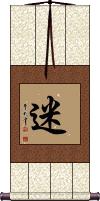
迷 is one of those characters that can mean a lot of different things depending on context. When written alone, as a single character on a wall scroll, it opens up the possibilities and allows you to decide what it means to you.
The key definition is “to be lost.” This could be physically or mentally lost. It can be someone lost in their thoughts, lost in an ocean, or just confused about where they are. The reason for the confused state may be due to internal or external reasons.
Here are some entries from various Asian dictionaries...
Chinese: lost, confused, bewilder, crazy about, fan, enthusiast, mystery.
Japanese: lost, astray, perplexed, in doubt, err, illusion.
Korean: lost, bewildered, fascinated, deluded.
Love
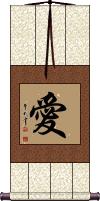
愛 universally means love in Chinese, Japanese Kanji, old Korean Hanja, and old Vietnamese.
愛 is one of the most recognized Asian symbols in the West and is often seen on tee shirts, coffee mugs, tattoos, and more.
愛 can also be defined as affection, to be fond of, to like, or to be keen on. It often refers to romantic love, and is found in phrases like, “I love you.” But in Chinese, one can say, “I love that movie” using this character as well.
This can also be a pet name or part of a pet name in the way we say “dear” or “honey” in English.
This can be a girl’s name “Ai” in both Chinese and Japanese.
More about this character:
This may be hard to imagine as a westerner but the strokes at the top of this love character symbolize family & marriage.
 The symbol in the middle is a little easier to identify. It is the character for "heart" (it can also mean "mind" or "soul"). I guess you can say that no matter if you are from the East or the West, you must put your heart into your love.
 The strokes at the bottom create a modified character that means "friend" or "friendship."
I suppose you could say that the full meaning of this love character is to love your family, spouse, and friends with all of your heart, since all three elements exist in this character.
See Also: I Love You | Caring | Benevolence | Friendliness | Double Happiness Happy Marriage Wall Scroll
Midori
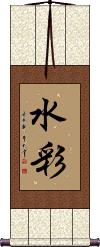
This can be a Japanese female given name that romanizes as Midori. Note: There are other Kanji combinations that romanize as Midori, this is not the only Midori out there.
Otherwise, and in other Asian languages, this means watercolor.
Mind Body Spirit
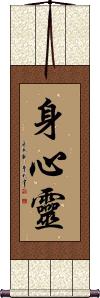
身心靈 is probably the best way to express the idea of “Body, Mind, and Spirit” in Chinese and old Korean Hanja. We are actually using the word “heart” here because, for thousands of years, the heart was thought to be the place where your thoughts, feelings, and emotions came from. We do something similar in the west when we say “warm-hearted” or “I love you with all of my heart.” In this context, heart = mind in Asian language and culture.
The very literal translation of these three characters is “body, heart & spirit,” which could also be interpreted as “body, mind & soul.”
We have arranged these characters in this order because it simply “feels” like the proper order in the Chinese language. Word lists like this are not so common for calligraphy artwork, so we must be careful to put them in the most natural order. It should be noted that this is not a common title in Asia, nor is it considered an actual phrase (as it lacks a clear subject, verb, and object).
 In Japanese Kanji, they use an alternate form of the character for soul or spirit. If you want this using the Japanese alternate, please click on the Kanji shown to the right instead of the button above.
Japanese disclaimer: This is not a natural phrase/list in Japanese. While not totally-natural in Chinese, this word list is best if your audience is Chinese.
Moon
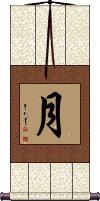
月 is how to write the title for “moon” in Chinese, Korean Hanja, and Japanese Kanji.
月 is also used to refer to the month. This is because China traditionally uses a lunar calendar, so saying “next moon” is the same as saying “next month” etc.
In modern Chinese and Japanese and old Korean, the character for a number is put in front of this moon character to represent western months. So “one moon” is January “two moons” is February etc.
If you are wondering, in the east Asian way to write dates, the character for “sun” or “day” is used with a number in front of it to express the day of the month. So “ten moons, one sun” becomes “October 1st” or “10/1” (this date happens to be Chinese National Day - The equivalent of Independence Day in the USA, Canada Day, or the Queen's Birthday).
In Japanese, 月 can be a surname that romanizes as Tsuki, Tsukizaki, or Takagetsu.
Morera
(second version)
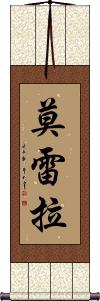
莫雷拉 is another way to transliterate the name Morera.
This version is commonly used but the middle character has an “L” sound instead of an “R.”
These two sounds are often interchanged in Asian languages. It's not a bad transliteration, it just sounds a bit like “Molela” instead of Morera.
Mother and Daughter
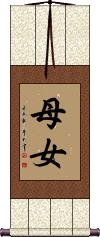
母女 means “mother and daughter” as a unit or as if mother and daughter are a whole together.
母女 is an unusual selection for a calligraphy wall scroll and can be read in many different ways. Your native Asian friends might wonder what you are trying to say. They might even read it as “a mother and daughter without a dad.”
This entry was added to our database for a customer's special request. It has the same meaning in Chinese Characters and Korean Hanja.
See Also: Mother and Son
Music
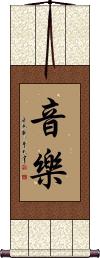
音樂 is how to write music in most Asian languages.
It can also express the idea of a musical movement, depending on context.
 The second character has morphed a bit in Japanese Kanji. If you want the specifically modern Japanese version, please click on the Kanji to the right, instead of the button above. The version shown to the left was used in ancient Japan, prior to the Japanese language reformations after WWII (so technically,
it’s
still Japanese).
The second character has morphed a bit in Japanese Kanji. If you want the specifically modern Japanese version, please click on the Kanji to the right, instead of the button above. The version shown to the left was used in ancient Japan, prior to the Japanese language reformations after WWII (so technically,
it’s
still Japanese).
Musician
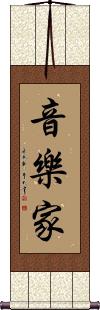
音樂家 is how to write “musician” in most Asian languages.
There is more than one way to express “musician” in China, but this is the traditional and most respectful title.
The second character has morphed a bit in Japanese Kanji. If you want the specifically modern Japanese version, please click on the Kanji to the right, instead of the button above. The version shown to the left was used in ancient Japan, prior to the Japanese language reformations after WWII (so technically,
it’s
still Japanese).
Naginata / Halberd
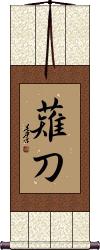
薙刀 is the Japanese word naginata.
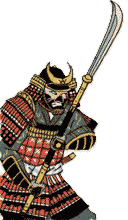 A naginata is a special kind of halberd or long sword carried by some Samurai and other warriors. It is still used ceremonially in some schools of martial arts.
Nashi
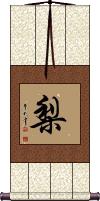
This Japanese Kanji means pear.
This refers specifically to the Pyrus pyrifolia and more specifically the culta variety. This is also known as the Japanese pear, Asian pear, sand pear, or apple pear.
梨 is also a female given name or surname in Japan that beyond Nashi, can be romanized as Rin, Rika, Ri, Nashisaki, or Shina.
In Chinese, this is pronounced like lee or li and just means pear.
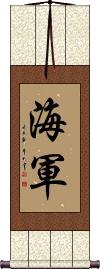
海軍 is the Chinese, Japanese Kanji, and Korean Hanja word for “Navy.” 海軍 is not country-specific, so it is the title for “naval service” from any country with a navy.
These two characters literally mean “sea military.”
A nice scroll for any sailor who likes Asian characters and has pride in their service.
Opera
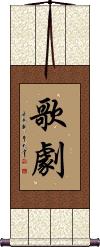
歌劇 is the Chinese, Japanese Kanji, and old Korean Hanja for opera.
This term applies in almost all cases to western opera versus Asian operas or musical plays.
Peace / Harmony
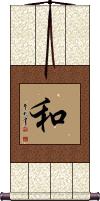
和 is the simplest form of peace and harmony.
和 can also be translated as the peaceful ideas of gentle, mild, kind, and calm. With a more harmonious context, it can be translated as union, together with, on good terms with, or on friendly terms.
Most people would just translate this character as peace and/or harmony. 和 is a very popular character in Asian cultures - you can even call it the “peace symbol” of Asia. In fact, this peace and harmony character was seen repeatedly during the opening ceremony of the 2008 Olympic Games in Beijing (a major theme of the games).
In old Chinese poems and literature, you might see this used as a kind of "and." As in two things summed together. As much as you could say, "the sun and moon," you could say "the sun in harmony with the moon."
See Also: Inner Peace | Patience | Simplicity
Phenomenon
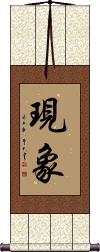
I must first say that 現象 is an odd thing to put on a wall scroll in Asian cultures. It won't make a lot of sense alone unless you have a special or personal meaning that you attach to it for yourself.
These two characters mean phenomenon in Chinese, Japanese, and Korean Hanja. They can also be translated as “a happening,” depending on context.
The sum of these characters is a little different than their individual meanings. But I will break it down anyway...
The first character means present, existing, actual, apparent, now, or current.
The second character alone means pattern after, imitate, image, shape, sign (of the times), form, appearance, to be like, to resemble, to take after, to seem, or elephant.
Mantis / Praying Mantis
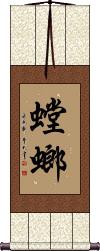
螳螂 is mantis or “praying mantis,” as it's often titled in English.
Technically speaking, this especially applies to the narrow-winged mantis (Tenodera angustipennis)
It is best to use this very common two-character Asian title for the mantis, as the second character alone can mean mantis or dragonfly (totally ambiguous).
This title is antiquated in Japanese, as they tend to write カマキリ (kama kiri) in Katakana to mean praying mantis.
 Note: There is an alternate form of this title which uses the character shown to the right instead of the first character shown above. This is uncommon in both Japan and China (if you really want it anyway, please let us know).
Purple / Violet
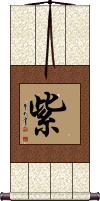
紫 is the single-character Chinese, Japanese, and old Korean title for the color violet/purple.
The difference between violet and purple is not really distinguished in Asian languages. However, sometimes a character for “light” is added to the front of this one, which might be closer to the meaning of violet.
Purple / Violet
(2 character version)
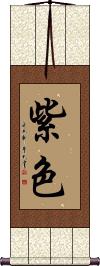
紫色 is the two-character Chinese, Japanese, and old Korean title for the color violet/purple.
The second character means “color,” so this literally means “violet color.”
It's more common to add the “color character” in Asian languages than to say “color” after the name of the color in English. Therefore, this is a natural way to express “violet” in Asian languages.
Rebel / Insurgent
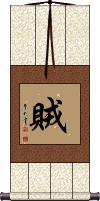
People keep asking me for rebel as a single Chinese character, Korean Hanja, or Japanese Kanji.
The problem is, rebel is not really a good word in Asian culture (depending on the context in which it is used). 賊 is a rebel symbol that can also mean thief; traitor; evil; robber; burglar; insurgent; or a spoiler. Used as an adjective, it can mean wily or deceitful.
Resurrection / Re-Birth
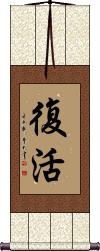
復活 is the Chinese, Japanese and Korean word for resurrection or rebirth.
復活 literally means “return to life.”
It is the term used in most Asian Bibles to refer to the resurrection of Christ. In Japanese, it is sometimes used to mean a Christian Revival. In some contexts, it can mean resuscitation.
See Also: Christianity | Jesus Christ | God of Abraham
Ritsu
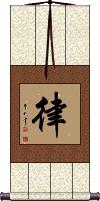
While this character literally means law, regulation or rules, it's also a surname Lü in Chinese and name Ritsu in Japanese.
In more ancient times (and for some people still), this can refer to East Asian criminal code, or vinaya (rules for the monastic community). For Japanese Buddhists, this can be the Ritsu school.
In some context, this can refer to certain musical scales used in Asia.
Rose Flower
(The flower of love)
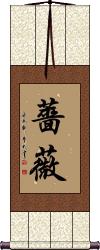
薔薇 is the universal way to write rose (as in the flower) because it is understood in both Chinese and Japanese (same characters in either language). 薔薇 is also a common way to write about roses in Asian poetry. This can be translated as “wild rose” if you are looking for that title.
薔薇 is also how to write “rose” in old Korean Hanja (though they now use Hangul, and most Koreans of this generation will not be able to read this without a dictionary).
Sincere Heart
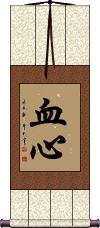
When you take 血心 apart, you find the sum is slightly different than the parts. The first character means blood, and the second means heart. It is important to note that for thousands of years, it was believed that your heart was both your soul and your mind in Asian culture. When you add blood to the heart, it is your whole being - the pure and clean dedication of your whole soul.
Most Chinese dictionaries define this as the sincerity of heart or a MEDICAL TERM!!!
Please think carefully before ordering this selection - it was only added as others have used this for coffee cups and other novelties (though perhaps naively).
Strong / Robust
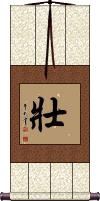
This “strong” character means “to strengthen” or robust. This brings images of a muscle-bound hulk of a weight lifter or bodybuilder to an Asian person who sees this character.
Note that in Korean and Japanese, this character is normally part of compound words, and is not seen alone too often.
 Note that the this character was simplified in Japan after WWII (also simplified in mainland China but not for calligraphy). If you want the modern Japanese/simplified version, please click on the Kanji shown to the right.
Sunshine
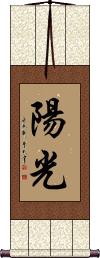
陽光 is the Chinese word for sunshine.
陽光 is a more emotional word compared to another Asian word that means “sunlight.” If you were going to sing a song or write a poem, this is the word you would use.
Note: This is a rarely-used word in Korean or Japanese.
Taekwondo
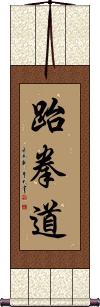
跆拳道 is one of the most widespread types of martial arts in the world as well as being an Olympic sport. Taekwondo was born in Korea with influences of Chinese and Japanese styles combined with traditional Korean combat skills. Some will define it as the “Korean art of empty-handed self-defense.”
In the simplest translation, the first character means “kick,” the second character can mean either “fist” or “punching,” and the third means “way” or “method.” Altogether, you could say this is the “Kick Punch Method.” When heard or read in various Asian languages, all will automatically think of this famous Korean martial art. It is written the same in Japanese Kanji, Chinese, and Korean Hanja characters - so the appearance of the characters is universal. However, you should note that there is another way to write this in modern Korean Hangul characters, which looks like the image to the right. 
We suggest the original Korean Hanja (Chinese characters) for a wall scroll, but if you need the Hangul version, you must use master calligrapher Cao Bin: Order Taekwondo in Korean Hangul
Note: Taekwondo is sometimes Romanized as Tae-Kwondo, Tae Kwon Do, Taekwon-do, Taegwondo, Tae Gweon Do, Tai Kwon Do, Taikwondo, Taekwando, Tae Kwan Do and in Chinese Taiquandao, Tai Quan Dao, Taichuando, or Tai Chuan Tao.
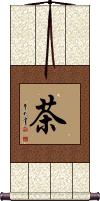
茶 means tea. It can refer to prepared tea (ready-to-drink) or dry tea leaves.
The origin of tea is China but the same character is used in Japanese Kanji, and old Korean Hanja with the exact same meaning. Japanese and Korean even borrowed the pronunciation from Chinese (pronounced “cha” in all three languages).
It's said that an early doctor (or herbologist) in ancient China kept poisoning himself as he tried different new herb concoctions. He invented tea as a means to detoxify himself as he recovered from 1 of the 76 times he nearly poisoned himself to death. Tea is seen not just as a drink but as a form of medicine used to remove impurities from the body.
The word “chai” (used in many languages to refer to various teas) is derived from this Chinese word.
茶 also means camellia, as Asian teas are often based on the leaves of camellia plant varieties.
Teacher / Master / Old Sage
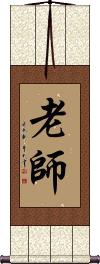
老師 directly translates as “old teacher,” “old master,” or “old sage.”
Together, they are understood as “teacher.” When you think about that, also realize that with age comes respect in Asian cultures. So calling someone old is a term of respect (not like the way we mean it in English). You could replace “old” with “respected” and be closer to how this is meant in Chinese.
Teachers, in general, are more respected by their students and the population in China. When I was a teacher in China, I certainly felt that.
This term is also used for masters of certain fields. For instance, a master calligrapher would respectfully be addressed as a “teacher.” In this case, “master” and “teacher” are synonymous.
Other artists (especially those who are famous or accomplished) should be addressed with this term. Also, some martial arts schools use this term of respect for their masters/teachers/instructors.
This title is recognized in Japanese as "roushi" with the same meaning but it’s rarely used in Japan.
Temperance
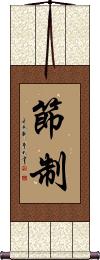
In short, 節制 or temperance is knowing when to say “when.”
Temperance is the practice of moderation and restraint (in fact, this Asian word is often translated as moderation or restraint).
It was one of the five tenets held to be vital to society in Hellenic culture. It is also one of the Four Cardinal Virtues considered central to Christian behavior by the Catholic Church.
Note: Also considered to be one of the Seven Heavenly Virtues.
Taekwondo Tenets / Spirit of Taekwon-do
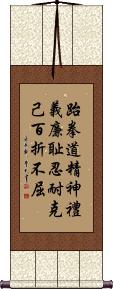
跆拳道精神禮義廉耻忍耐克己百折不屈 is General Choi's writing that is often called “The Tenets of Taekwon-do.”

The actual title would be translated as “Taekwondo Spirit” or “The Spirit of Taekwondo.” It was originally written in Korean Hanja (Chinese characters used in Korea for about 1600 years).
General Choi's original calligraphy is shown to the right. Your custom calligraphy will be unique, and not an exact match, as each calligrapher has their own style.In modern times, the common form of written Korean is Hangul (a phonetic character set). The table below shows the text in Hangul and Hanja along with a pronunciation guide and a brief English translation:
| Traditional Korean Hanja | Modern Korean Hangul | Pronunciation | English |
| 跆拳道精神 | 태권도정신 | tae gweon do jeong sin | Taekwondo Spirit |
| 禮儀 | 예의 | ye yi | Courtesy / Etiquette / Propriety / Decorum / Formality |
| 廉耻 | 염치 | yeom ci | Integrity / Sense of Honor |
| 忍耐 | 인내 | in nae | Patience / Perseverance / Endurance |
| 克己 | 극기 | geug gi | Self-Control / Self-Denial / Self-Abnegation |
| 百折不屈 | 백절불굴 | baeg jeor bur gur | Indomitable Spirit (Undaunted even after repeated attacks from the opponent) |
| Note that the pronunciation is the official version now used in South Korea. However, it is different than what you may be used to. For instance, “Taekwon-do” is “tae gweon do.” This new romanization is supposed to be closer to actual Korean pronunciation. | |||
The Holy Trinity
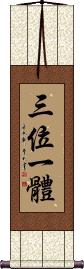
三位一體 is the Chinese and old Korean way to write Holy Trinity.
This would be understood in Japanese as well, but they tend to write it with the last character simplified like 三位一体 in modern Japan.
This can be translated literally as “Three Thrones, One Body.”
Asian Christians will understand this as the Trinity, God the Father, the Son, and the Holy Spirit.
Thug Life
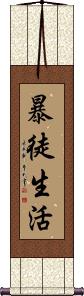
暴徒生活 is probably the best way to say “Thug Life” in Chinese, Japanese, and Korean.
It's a strange title, to be sure, so expect native Asian people to be confused when they see your Thug Life calligraphy.
The first two characters mean bandit, thug, ruffian, insurgent, rioter, or mob.
The last two characters mean life, live, or living.
In Wine there is Truth
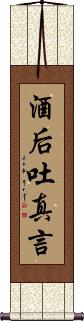
酒后吐真言 / 酒後吐真言 is a nice Asian proverb if you know a vintner or wine seller - or wine lover - although the actual meaning might not be exactly what you think or hope.
The literal meaning is that someone drinking wine is more likely to let the truth slip out. It can also be translated as “People speak their true feelings after drinking alcohol.”
It's long believed in many parts of Asia that one can not consciously hold up a facade of lies when getting drunk, and therefore the truth will come out with a few drinks.
I've had the experience where a Korean man would not trust me until I got drunk with him (I was trying to gain access to the black market in North Korea which is tough to do as an untrusted outsider) - so I think this idea is still well-practiced in many Asian countries.
 VS
VS 
Please note that there are two common ways to write the second character of this phrase. The way it's written will be left up to the mood of the calligrapher, unless you let us know that you have a certain preference.
Vampire
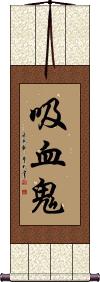
吸血鬼 is how to say “vampire” in Chinese, Japanese Kanji, and old Korean Hanja.
Quite literally, this means “Suck Blood Ghost” or, more naturally, in English, “Ghost Who Sucks Blood.” This title is also used for leeches and blood-sucking vermin.
Just like the word “vampire” in English, this title is used in Asian languages colloquially to refer to “cruel exploiters,” and especially in China, it can be used to refer to “capitalists exploiting the workers.”
Alone on a wall scroll, this will be understood with just the “vampire” or “bloodsucker” meaning.
Wing Chun Fist Maxims (Part 1)
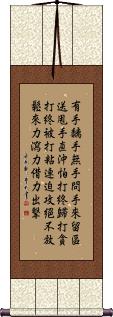
A customer asked me to split these Wing Chun maxims into two parts, so he could order a couplet. I thought this was a good idea, so it's been added here.
1 有手黐手,無手問手
2 來留區送, 甩手直沖
3 怕打終歸打, 貪打終被打
4 粘連迫攻, 絕不放鬆
5 來力瀉力, 借力出擊
A couplet is a set of two wall scrolls that start and finish one phrase or idea. Often, couplets are hung with the first wall scroll on the right side, and the second on the left side of a doorway or entrance. The order in Chinese is right-to-left, so that's why the first wall scroll goes on the right as you face the door.
Of course, couplets can also be hung together on a wall. Often they can be hung to flank an altar, or table with incense, or even flanking a larger central wall scroll. See an example here from the home of Confucius
Be sure to order both parts 1 and 2 together. One without the other is like Eve without Adam.
Wolf Spirit / Soul of a Wolf
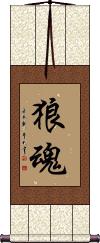
狼魂 means wolf spirit, but is an unusual title in Chinese and Japanese.
Many people have searched for this title, so I added it. The wolf is not usually seen in a positive light in Asian culture, so this may not be the best title to label yourself.
This in-stock artwork might be what you are looking for, and ships right away...
Gallery Price: $220.00
Your Price: $138.88

Gallery Price: $60.00
Your Price: $34.88
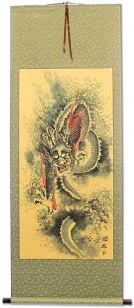

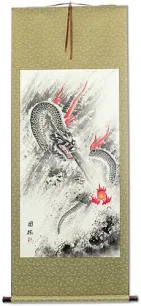
Gallery Price: $300.00
Your Price: $138.88
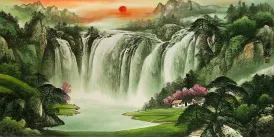
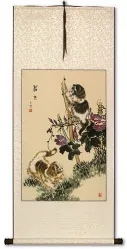
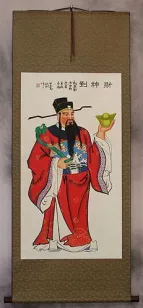

The following table may be helpful for those studying Chinese or Japanese...
| Title | Characters | Romaji (Romanized Japanese) | Various forms of Romanized Chinese | |
| Air Atmosphere | 空氣 空气 / 空気 | kuu ki / kuuki / ku ki | kōng qì / kong1 qi4 / kong qi / kongqi | k`ung ch`i / kungchi / kung chi |
| Animals | 動物 动物 | doubutsu / dobutsu | dòng wù / dong4 wu4 / dong wu / dongwu | tung wu / tungwu |
| Appreciation of Truth by Meditation | 心印 | shin nin / shinnin | xīn yìn / xin1 yin4 / xin yin / xinyin | hsin yin / hsinyin |
| Asia Asian Continent | 亞洲 亚洲 | yà zhōu / ya4 zhou1 / ya zhou / yazhou | ya chou / yachou | |
| Asia Asian Continent | 亜細亜 | a ji a / ajia | ||
| Asian Pride Oriental Pride AZN Pryde | 東方自尊 东方自尊 | tou hou zi son touhouzison to ho zi son | dōng fāng zì zūn dong1 fang1 zi4 zun1 dong fang zi zun dongfangzizun | tung fang tzu tsun tungfangtzutsun |
| Bamboo | 竹 | take | zhú / zhu2 / zhu | chu |
| Banzai Wansui | 萬歲 万岁 | banzai / manzai | wàn suì / wan4 sui4 / wan sui / wansui | |
| Banzai | 万歲 / 萬歲 万岁 | banzai | wàn suì / wan4 sui4 / wan sui / wansui | |
| Beautiful | 美麗 美丽 | birei | měi lí / mei3 li2 / mei li / meili | |
| You are always a beauty in your lover’s eyes | 情人眼里出西施 | qíng rén yǎn lǐ chū xī shī qing2 ren2 yan3 li3 chu1 xi1 shi1 qing ren yan li chu xi shi qingrenyanlichuxishi | ch`ing jen yen li ch`u hsi shih chingjenyenlichuhsishih ching jen yen li chu hsi shih |
|
| Beauty Shop Beauty Salon | 美容店 | měi róng diàn mei3 rong2 dian4 mei rong dian meirongdian | mei jung tien meijungtien |
|
| Kindness Benevolence | 仁慈 | jin ji / jinji | rén cí / ren2 ci2 / ren ci / renci | jen tz`u / jentzu / jen tzu |
| Big Wave | 濤 涛 | nami | tāo / tao1 / tao | t`ao / tao |
| Chong Sung Su | 崇 | sū | chóng / chong2 / chong | ch`ung / chung |
| Cobra | 眼鏡蛇 眼镜蛇 | me gane hebi meganehebi | yǎn jìng shé yan3 jing4 she2 yan jing she yanjingshe | yen ching she yenchingshe |
| Do not shed a tear until you see the coffin | 不見棺材不落淚 不见棺材不落泪 | bú jiàn guān cái bú luò lèi bu2 jian4 guan1 cai2 bu2 luo4 lei4 bu jian guan cai bu luo lei bujianguancaibuluolei | pu chien kuan ts`ai pu lo lei puchienkuantsaipulolei pu chien kuan tsai pu lo lei |
|
| Community | 社區 社区 | shè qū / she4 qu1 / she qu / shequ | she ch`ü / shechü / she chü | |
| Crazy Mad Wild | 狂 狂 | kyou / kyo | kuáng / kuang2 / kuang | k`uang / kuang |
| Crisis equals Danger plus Opportunity? | 危機 危机 | kiki | wēi jī / wei1 ji1 / wei ji / weiji | wei chi / weichi |
| Crystal | 水晶 | suishou / suisho | shuǐ jīng shui3 jing1 shui jing shuijing | shui ching shuiching |
| Daisy | 雛菊 雏菊 | hinagiku | chú jú / chu2 ju2 / chu ju / chuju | ch`u chü / chuchü / chu chü |
| Dignity Honor Sanctity Integrity | 尊嚴 尊严 / 尊厳 | son gen / songen | zūn yán / zun1 yan2 / zun yan / zunyan | tsun yen / tsunyen |
| Double Happiness Guest Book | 囍 喜喜 | xǐ / xi3 / xi | hsi | |
| Dragon Emperor Symbol | 竜 | ryuu / tatsu ryu / tatsu | lóng / long2 / long | lung |
| Eagle Falcon Hawk | 鷹 鹰 | taka | yīng / ying1 / ying | |
| Easter | 復活節 复活节 | fù huó jié fu4 huo2 jie2 fu huo jie fuhuojie | fu huo chieh fuhuochieh |
|
| Amitabha Buddha | 阿彌陀佛 阿弥陀佛 | amida butsu amidabutsu | ē mí tuó fó e1 mi2 tuo2 fo2 e mi tuo fo emituofo | o mi t`o fo omitofo o mi to fo |
| Enso - Japanese Zen Circle | 〇 | en sou / ensou / en so | ||
| Let Us Try | 嘗試 尝试 | cháng shì chang2 shi4 chang shi changshi | ch`ang shih changshih chang shih |
|
| Eye for an eye | 以眼還眼 以眼还眼 | yǐ yǎn huán yǎn yi3 yan3 huan2 yan3 yi yan huan yan yiyanhuanyan | i yen huan yen iyenhuanyen |
|
| A Bright Future | 鵬程萬里 鹏程万里 | péng chéng wàn lǐ peng2 cheng2 wan4 li3 peng cheng wan li pengchengwanli | p`eng ch`eng wan li pengchengwanli peng cheng wan li |
|
| Flower in the Mirror, Moon on Water | 鏡花水月 镜花水月 | kyou ka sui getsu kyoukasuigetsu kyo ka sui getsu | jìng huā shuǐ yuè jing4 hua1 shui3 yue4 jing hua shui yue jinghuashuiyue | ching hua shui yüeh chinghuashuiyüeh |
| Forgive | 寬恕 / 寛恕 宽恕 | kan jo / kanjo | kuān shù / kuan1 shu4 / kuan shu / kuanshu | k`uan shu / kuanshu / kuan shu |
| Forgiveness | 恕 | shù / shu4 / shu | ||
| Gem | 珠玉 | shugyoku | zhū yù / zhu1 yu4 / zhu yu / zhuyu | chu yü / chuyü |
| Grace from Heaven Grace from God | 天恩 | tiān ēn / tian1 en1 / tian en / tianen | t`ien en / tienen / tien en | |
| Griffin Gryphon | 鷹頭獅 鹰头狮 | yīng tóu shī ying1 tou2 shi1 ying tou shi yingtoushi | ying t`ou shih yingtoushih ying tou shih |
|
| Guanxi | 關繫 / 関繫 / 關係 关系 / 関係 | kankei | guān xì / guan1 xi4 / guan xi / guanxi | kuan hsi / kuanhsi |
| Gung Ho | 工合 | guai | gōng hé / gong1 he2 / gong he / gonghe | kung ho / kungho |
| Heaven | 天 | ten | tiān / tian1 / tian | t`ien / tien |
| Words Have Enormous Weight: One Word Worth Nine Caldrons | 一言九鼎 | yī yán jiǔ dǐng yi1 yan2 jiu3 ding3 yi yan jiu ding yiyanjiuding | i yen chiu ting iyenchiuting |
|
| Speed | 高速 | kousoku / kosoku | gāo sù / gao1 su4 / gao su / gaosu | kao su / kaosu |
| Holy Mother Saint Mary | 聖母 圣母 | seibo | shèng mǔ / sheng4 mu3 / sheng mu / shengmu | |
| Honor and Integrity | 節操 节操 | sessou / seso | jié cāo / jie2 cao1 / jie cao / jiecao | chieh ts`ao / chiehtsao / chieh tsao |
| Achieve Inner Peace; Find Deep Understanding | 寧靜而致遠 宁静而致远 | níng jìng ér zhì yuǎn ning2 jing4 er2 zhi4 yuan3 ning jing er zhi yuan ningjingerzhiyuan | ning ching erh chih yüan ningchingerhchihyüan |
|
| Jackie Chan | 成龍 成龙 | jakkii chiin jakkiichiin jaki chin | chéng lóng cheng2 long2 cheng long chenglong | ch`eng lung chenglung cheng lung |
| Joshua 24:15 | 至於我和我家我們必定事奉耶和華 至于我和我家我们必定事奉耶和华 | zhì yú wǒ hé wǒ jiā wǒ men bì dìng shì fèng yē hé huá zhi4 yu2 wo3 he2 wo3 jia1 wo3 men bi4 ding4 shi4 feng4 ye1 he2 hua2 zhi yu wo he wo jia wo men bi ding shi feng ye he hua | chih yü wo ho wo chia wo men pi ting shih feng yeh ho hua | |
| Kana | 伽那 | kana | jiā nà / jia1 na4 / jia na / jiana | chia na / chiana |
| Karma (of your past lives) | 宿業 宿业 | shukugou / shukugo | sù yè / su4 ye4 / su ye / suye | su yeh / suyeh |
| Katana | 刀 | katana | dāo / dao1 / dao | tao |
| King | 王 | ou / o | wáng / wang2 / wang | |
| Kirin Giraffe Mythical Creature | 麒麟 | kirin | qí lǐn / qi2 lin3 / qi lin / qilin | ch`i lin / chilin / chi lin |
| Life Energy Spiritual Energy | 氣 气 / 気 | ki | qì / qi4 / qi | ch`i / chi |
| Listen to Both Sides and be Enlightened, Listen to One Side and be in the Dark | 兼聽則明偏聽則暗 兼听则明偏听则暗 | jiān tīng zé míng, piān tīng zé àn jian1 ting1 ze2 ming2, pian1 ting1 ze2 an4 jian ting ze ming, pian ting ze an | chien t`ing tse ming, p`ien t`ing tse an chien ting tse ming, pien ting tse an |
|
| Live Laugh Love | 笑愛生活 笑爱生活 | xiào ài shēng huó xiao4 ai4 sheng1 huo2 xiao ai sheng huo xiaoaishenghuo | hsiao ai sheng huo hsiaoaishenghuo |
|
| Lost Dazed and Confused | 迷 | mei | mí / mi2 / mi | |
| Love | 愛 爱 | ai | ài / ai4 / ai | |
| Midori | 水彩 | midori | shuǐ cǎi / shui3 cai3 / shui cai / shuicai | shui ts`ai / shuitsai / shui tsai |
| Mind Body Spirit | 身心靈 / 身心霊 身心灵 | mi shin rei mishinrei | shēn xīn líng shen1 xin1 ling2 shen xin ling shenxinling | shen hsin ling shenhsinling |
| Moon | 月 | tsuki | yuè / yue4 / yue | yüeh |
| Morera | 莫雷拉 | mò léi lā mo4 lei2 la1 mo lei la moleila | ||
| Mother and Daughter | 母女 | mǔ nǚ / mu3 nv3 / mu nv / munv | mu nü / munü | |
| Music | 音樂 音乐 / 音楽 | ongaku | yīn yuè / yin1 yue4 / yin yue / yinyue | yin yüeh / yinyüeh |
| Musician | 音樂家 音乐家 / 音楽家 | ongakuka | yīn yuè jiā yin1 yue4 jia1 yin yue jia yinyuejia | yin yüeh chia yinyüehchia |
| Naginata Halberd | 薙刀 | naginata | ||
| Nashi | 梨 | nashi | lí / li2 / li | |
| Navy | 海軍 海军 | kaigun | hǎi jūn / hai3 jun1 / hai jun / haijun | hai chün / haichün |
| Opera | 歌劇 歌剧 | kageki | gē jù / ge1 ju4 / ge ju / geju | ko chü / kochü |
| Peace Harmony | 和 | wa | hé / he2 / he | ho |
| Phenomenon | 現象 现象 | genshou / gensho | xiàn xiàng xian4 xiang4 xian xiang xianxiang | hsien hsiang hsienhsiang |
| Mantis Praying Mantis | 螳螂 / 蟷螂 螳螂 | tou rou / tourou / to ro | táng láng tang2 lang2 tang lang tanglang | t`ang lang tanglang tang lang |
| Purple Violet | 紫 | murasaki | zǐ / zi3 / zi | tzu |
| Purple Violet | 紫色 | murasakiiro murasakiro | zǐ sè / zi3 se4 / zi se / zise | tzu se / tzuse |
| Rebel Insurgent | 賊 贼 | zoku | zéi / zei2 / zei | tsei |
| Resurrection Re-Birth | 復活 复活 | hukkatsu / hukatsu | fù huó / fu4 huo2 / fu huo / fuhuo | |
| Ritsu | 律 | ritsu | lǜ / lu:4 / lu: | lü |
| Rose Flower | 薔薇 蔷薇 | bara / shoubi bara / shobi | qiáng wēi qiang2 wei1 qiang wei qiangwei | ch`iang wei chiangwei chiang wei |
| Sincere Heart | 血心 | xuě xīn / xue3 xin1 / xue xin / xuexin | hsüeh hsin / hsüehhsin | |
| Strong Robust | 壯 壮 | sou / so | zhuàng / zhuang4 / zhuang | chuang |
| Sunshine | 陽光 阳光 | you kou / youkou / yo ko | yáng guāng yang2 guang1 yang guang yangguang | yang kuang yangkuang |
| Taekwondo | 跆拳道 | te kon do / tekondo | tái quán dào tai2 quan2 dao4 tai quan dao taiquandao | t`ai ch`üan tao taichüantao tai chüan tao |
| Tea | 茶 | cha | chá / cha2 / cha | ch`a / cha |
| Teacher Master Old Sage | 老師 老师 | lǎo shī / lao3 shi1 / lao shi / laoshi | lao shih / laoshih | |
| Temperance | 節制 节制 | sessei / sesei | jié zhì / jie2 zhi4 / jie zhi / jiezhi | chieh chih / chiehchih |
| Taekwondo Tenets Spirit of Taekwon-do | 跆拳道精神禮義廉耻忍耐克己百折不屈 跆拳道精神礼义廉耻忍耐克己百折不屈 | tái quán dào jīng shén lǐ yì lián chǐ rěn nài kè jǐ bǎi zhé bù qū tai2 quan2 dao4 jing1 shen2 li3 yi4 lian2 chi3 ren3 nai4 ke4 ji3 bai3 zhe2 bu4 qu1 tai quan dao jing shen li yi lian chi ren nai ke ji bai zhe bu qu | t`ai ch`üan tao ching shen li i lien ch`ih jen nai k`o chi pai che pu ch`ü tai chüan tao ching shen li i lien chih jen nai ko chi pai che pu chü |
|
| The Holy Trinity | 三位一體 三位一体 | sān wèi yì tǐ san1 wei4 yi4 ti3 san wei yi ti sanweiyiti | san wei i t`i sanweiiti san wei i ti |
|
| Thug Life | 暴徒生活 | bou to sei katsu boutoseikatsu bo to sei katsu | bào tú shēng huó bao4 tu2 sheng1 huo2 bao tu sheng huo baotushenghuo | pao t`u sheng huo paotushenghuo pao tu sheng huo |
| In Wine there is Truth | 酒后吐真言 / 酒後吐真言 酒后吐真言 | jiǔ hòu tǔ zhēn yán jiu3 hou4 tu3 zhen1 yan2 jiu hou tu zhen yan jiuhoutuzhenyan | chiu hou t`u chen yen chiuhoutuchenyen chiu hou tu chen yen |
|
| Vampire | 吸血鬼 | kyuu ketsu ki kyuuketsuki kyu ketsu ki | xī xuě guǐ xi1 xue3 gui3 xi xue gui xixuegui | hsi hsüeh kuei hsihsüehkuei |
| Wing Chun Fist Maxims (Part 1) | 有手黐手無手問手來留區送甩手直沖怕打終歸打貪打終被打粘連迫攻絕不放鬆來力瀉力借力出擊 有手黐手无手问手来留区送甩手直冲怕打终归打贪打终被打粘连迫攻绝不放松来力泻力借力出击 | |||
| Wolf Spirit Soul of a Wolf | 狼魂 | routama / ookami tamashii routama / ookamitamashii rotama / okami tamashi | láng hún / lang2 hun2 / lang hun / langhun | |
| In some entries above you will see that characters have different versions above and below a line. In these cases, the characters above the line are Traditional Chinese, while the ones below are Simplified Chinese. | ||||